Year Released: 1985
Original Price: £299 (with green-screen monitor), £399 (with colour monitor)
Buy It Now For: £25+
Associated magazines: Amtix, Computing With The Amstrad, Amstrad Computer User, CPC Attack, Amstrad Action
Why The Amstrad CPC 6128 Was Great: It may not have been as cool or as desirable as a Commodore 64, but the CPC 6128 was arguably the greatest 8-bit machine ever made. Adaptable (plug in a tape drive, fiddle endlessly with the volume control and you had a 464 with knobs on) and dependable, there was a mountain of games, a thriving community, and a real spirit of the underdog.
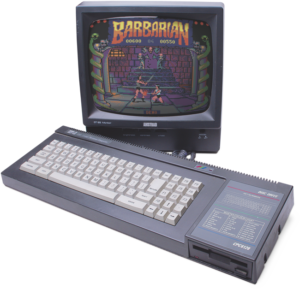
Sitting atop a chunky slab of plastic, the CPC 664’s white and blue keys and the clumsy-looking addition of a disk drive exuded such ugliness that you couldn’t help but feel sorry for the poor sods who bought it. It was a step up from Amstrad’s iconic cassette-based 464 in the sense that it added a three-inch disk drive of the like seen in the Oric Atmos, some extra BASIC commands and both the AMSDOS and CP/M 2.2 operating systems. But while it sold around 10,000 units, within five months it was replaced by the 6128 – a machine which not only doubled the memory of its predecessor but looked far sleeker, too.
And so it was that the CPC 6128 came into being. It was launched in America in 1985 and it came to Europe shortly afterwards, making its UK debut at a glitzy press conference in London with BBC newsreader Richard Whitmore overseeing proceedings. Boasting the same three-inch drive, the only real features to distinguish the 6128 from the 664 were the 128K of RAM and a better, plain white, springier keyboard. The extra memory was an important addition, however, as it was used as a RAM disk or to store data such as gaming levels.
In some cases, the 128K versions of CPC games would carry sound not heard in their 64K counterparts and all of this allowed developers to give their titles a little boost from time to time. Before its unveiling, Mr Whitmore led the assembled journalists and dealers through a potted history of Amstrad. But it was Sir Alan Sugar himself who whipped the covers off the 6128 to show his new machine in all its glory. In doing so, he declared the 664 “well and truly dead” and he said the new arrival was due to “a leap in technology”. He later stated that the 6128 was aimed at a more serious buyer, although the decision to make the machine compatible with 464 and 664 software created an instant back catalogue of games for the new machine.
 “There was a simple reason for launching the CPC 6128,” says Cliff Lawson, who worked on the product launch of both the 6128 and 664. “It could be produced for the same money as the 664 so Amstrad decided it would be wise to go for the better product. It offered the punter more and it was, dare I say, much prettier, too.”
The 6128 was one of two computers to be unveiled by Amstrad at the same time. The other was the PCW8256, pitched mainly at businesses. That machine came with a monochrome monitor, 256K of memory, a built-in disk drive, a printer and word-processing software, but it wasn’t compatible with the CPC and there was no intention of opening its appeal to gamers. The PCW retailed at £460 and, as the trumpets blared for the 6128, the 464 was cut in price, bringing its cost down to £199 for the green-screen version and £299 for colour. In some sense, it meant that the 6128 was a halfway house – part business, part pleasure – bridging the gap between the PCW and the 464.
One of the first games to take advantage of the added capacity that the extra 64K of the 6128 offered was Sorcery+. Released in 1985, players of this disk-based joystick-only game saw many enhancements over the original Sorcery, including an extra 35 screens. Amstrad loved the lush look so much that it used screens of the game in its promotional literature and yet such enhancements didn’t become the norm.
 Although it was possible for both 464 and 664 owners to buy a 64K memory pack, which could be inserted into an expansion slot at the back of both computers (Datel Electronics would advertise Dk’tronics’ 64K memory on a monthly basis), sales were not sufficiently high enough for all developers to put in the extra effort of creating additional enhancements. The gaming benefits of purchasing extra memory were not heavily pushed either, so whether or not a game carried the extra power depended on the whim of the developer or, in some cases, the near impossibility of making a game as impressive in 64K as it would be using double that memory.
Indeed, as the 6128 launched, some developers decided they wouldn’t be sticking their neck out in support of the added extras of the new machine. Paula Byrne, of Melbourne House, said she would see how well the machine sold and Taskset’s Paul Hodgson felt Amstrad missed an opportunity to enhance the graphics and sound chips and said he had no immediate plans to make games for it. But it wasn’t all doom and gloom. Gremlin’s Ian Stewart said it paved the way for better games and his company certainly made use of the new facilities on offer as the years went on.
“Amstrad didn’t encourage 128K disk-based games to be produced,” admits Cliff. “It wasn’t particularly important since the extra memory was seen to have greater use with serious applications. The 64K games at the time worked well on the full range of Amstrad’s CPC machines and it was in everyone’s interest to ensure titles operated across the entire range and that the market wouldn’t be split.”
 Around six months after launch, both the 6128 and the PCW were doing well. Amstrad announced £27.5 million half-yearly profits in April 1986 with sales in the six months to December 1985 increasing from £69 million to £128 million. The PCW8256 accounted for 20 per cent of the company’s turnover, but the 6128 was becoming a market leader in France, as well as making major inroads into Germany and Spain.
Yet, for the average gamer, such corporate guff mattered little. They were more interested in enjoying some of the gems which were launched over the course of the 6128’s life span. As time went on, more games arrived that could only be played with 128K of memory. They included Gremlin’s Nigel Mansell’s World Championship, one of the best Formula 1 games ever launched on the Amstrad and a title which deservedly won it much praise in the CPC gaming press.
Indeed, Gremlin, as we have discussed, liked to use the extra RAM to get the best out of its games. It produced 128K versions of Space Crusade and Super Cars. And titles such as HeroQuest and Switchblade contained music on the 6128, whereas, on an unexpanded 464, there were no tunes at all. Some differences were more subtle, however. “In Lotus Esprit Turbo Challenge,” explains Nicholas Campbell, the CPC Games Review webmaster, “the only difference, as far as I am aware, is that the ‘handbook’ (the screens displaying the car’s specifications) is loaded separately on the 64K version, whereas it is included with the main game in the 128K version.”
 There was more… Level 9’s games, including Gnome Ranger, Ingrid’s Back, Knight Orc, Lancelot and Scapeghost, did not contain graphics on a non-enhanced 464, but the 6128 proudly showed off a host of pictures. This was also the case with The Famous Five as well as all four of Magnetic Scrolls’ adventures for the CPC (The Pawn, The Guild Of Thieves, Jinxter and Corruption), which were only playable if 128K was available.
Add to that little list less prestigious titles such as European Superleague and Computer Scrabble De Luxe, throw in the likes of Final Fight (this game came on a dual-format disk with the Spectrum version on the other side), tag on Gauntlet III, G-LOC, Gunboat, and most of Microïds’ later releases – Killerball, Sliders and Swap – No Exit, Pirates!, then make space for all four of Silmarils’ releases (Windsurf Willy, Targhan, Xyphoes Fantasy and Bunny Bricks), SWIV and Times Of Lore and you had a pretty good reason to go for Amstrad’s best machine at the time. If nothing else, the extra vocal samples on Chase H.Q. were probably worth the price of an upgrade alone. Well, probably anyway…
Four Great Amstrad CPC 6128 Games
 Barbarian
 Head Over Heels
 1942
1942
 Prince Of Persia
Read the full feature in Retro Gamer issue 59, on sale digitally from GreatDigitalMags.com
Retro Gamer magazine and bookazines are available in print from ImagineShop