As a huge book and game fan, Tiny Bookshop spoke to me on many levels. And so, I was super happy to get the chance to speak to David Wildemann, Neoludic’s Co-CEO and Creative Director, all about how Tiny Bookshop came about and where it may go next.
You can read my glowing Tiny Bookshop review for a deeper look at the gameplay, or head on down to see just why that seagull appears in the bookshop demanding a new piece of literature, where the game is really set (or not, as the case may be), and whether another Tiny business game may ever come to fruition.
Pocket Tactics: Firstly, a big congratulations! Tiny Bookshop remains in the top 20 entries on the Steam Charts, and at the top of the Nintendo eShop chart (as of writing up questions on August 18). Did you expect this many eager booksellers to grab the game?
David Wildemann: I always thought of it as a game for a very specific audience. People who love bookshops, used books, tiny houses, and a slow and fulfilling life. That so many people are drawn to that fantasy and our little game has truly surprised me!
Where did the initial idea for Tiny Bookshop come from, and what inspired the particular art style the game has?
I’ve always been intrigued by “Tiny living.” When we finished school, my now fiancé and I bought a beat-up camper-van in the hopes of travelling for a year before starting uni. It broke down on the second trip, but we still spent 3 wonderful months on the road. One thing that stuck with me from that experience was the desire to actually arrive somewhere and become part of a community, instead of just being a passerby.
Then 2019, after a small burnout from studying in two places at once during an exchange semester, I came across the Custard Square bookshop in Christchurch. It’s a little yellow wagon filled with second-hand books, all for the same price. Next to it, in the shade of an umbrella, sat an older gentleman, reading a book of his own. I knew I wanted to do this, too!
So after arriving back in our flat, I started researching wagons in Germany, where to get used books, etc. But because I couldn’t do that right away, I somehow switched to making a card-game prototype about this daydream instead. From there, the game grew, first into a Bachelor’s thesis together with Raven (Co-CEO and Art Director Raven Rusch), then slowly into a prototype, and finally, the finished game.
Did you contact real booksellers or bookshops during the making of Tiny Bookshop? Have any of the team members had their own experience with selling books?
We didn’t actively reach out to booksellers, but maybe unsurprisingly, a couple of our play testers ended up being from book-related trades.
Is Bookstonbury based on anywhere in particular?
Our goal was to create a place that felt like it’s everywhere in Europe. A place that you could visit for a weekend getaway, or to really start over. So we drew from places that we had visited and that had this pull on us, too. The places we drew the most inspiration from were Hay-on-Wye in Wales, St. Andrews in Scotland, and Bad Gastein in Austria.
There’s a good cast of characters featuring kindly old ladies, a metalhead, a goth gal, and adorable Harper – did you know from the start that you wanted memorable characters to form part of the story? Were there any specific inspirations for any of them? Related to that, it feels like there are some romantic undertones with a couple of characters. Was this intended?
From the beginning, I knew I wanted a sense of progression in the game to come from characters and memories, and not from the money counter going up. Tilde and Anne both already existed in the first card game prototype, while the other characters emerged naturally around the places we came up with and the activities we wanted to explore. We really wanted to explore how different people in a community would interact with a bookshop and its shopkeeper.
How did you choose the books and genres that appear in the game?
That’s a lovely question! When I started designing the game, I knew I wanted the main choices of the game to be: Where do you go? What books do you bring?
To make it possible to anticipate the needs of your customers at different locations, I wanted the genres to be as evocative of a specific type of book and a person who wants it as possible. Quickly being able to make these choices also meant that the number of genres had to be limited. Otherwise, it could have become too complicated to remember the genre needs, and cumbersome to track your stock. Very early screenshots of the game reveal that we only had 6 genres in the beginning.
Of course, the selection we ended up making was based on the kinds of people, quests, and places we wanted to put in Bookstonbury. So we have sacrificed some accuracy and detail for a more interesting and approachable game world.
The recommendation mechanic arrived a little later in development. When deciding which books to pick for it, we wanted to truly evoke the feeling of entering a used bookshop. So we visited a bunch of them in Hay-on-Wye, to get a baseline of second-hand bookshop classics. Then, we wanted to shine a light on some of our favourites, newer authors, and other voices. Some of our favourites also snuck into the game.

A lot of players express the desire to see which specific books you’re adding to the shelves. Would you add more genres, or the ability to change them – specifically, horror may be a good idea, as a lot of Bookston’s denizens love a bit of gore, it seems!
That’s very understandable! Perhaps we’ll add another genre later down the line, now that everyone has had time to familiarize themselves with the core gameplay of Tiny Bookshop. But it would be a difficult call between Romance and Horror.
I had actually built a prototype about half a year ago to test, showing which exact book it was that you were stocking, and allowing you to change that. It quickly made the experience very tedious, because picking one out of 350 books 40 to 100 times is a lot more draining than painting in one of seven genres. But I’m still thinking of ways to allow more control over the books that show up on the shelves, but it’s a tricky problem to solve.
I encountered a seagull asking for a book (I think that’s what ‘Gwak’ meant). I gave it a kids’ book and it was happy – which book(s) does the seagull enjoy?
Haha, most! It avoids long and very long books. And really loves books with food or animals in them.
Are there any plans for DLC? Maybe including the island in the distance, more locations, more books, more friendly NPCs?
We’ve had to cut a couple of locations and characters that are still close to our hearts. Perhaps we’ll be able to return to them. We don’t have any concrete plans yet, and I personally am in big need of a break first.

Is there any chance for another Tiny game focused on a different sort of business? Or, similar to asking about DLC above, some sort of update to add different product types?
We’ve had a couple [of] ideas and suggestions on this. A Tiny Vinyl shop? A Tiny Bike Shop? A Tiny Antiques Shop? So far, used books have had the biggest pull on us, and we wanted to really lean in on them. A different shop would have required a different world around it, with different characters, events, quests, and so on. It’s fun to think about the “parallel universes” of Tiny Bookshops.
Would Tiny Bookshop ever make its way to mobile? Perhaps on Apple Arcade or via a service like Netflix.
I think the game would play wonderfully on tablets! So far, our focus has been on PC and consoles, but we’re not at all opposed to bringing it to mobile later.
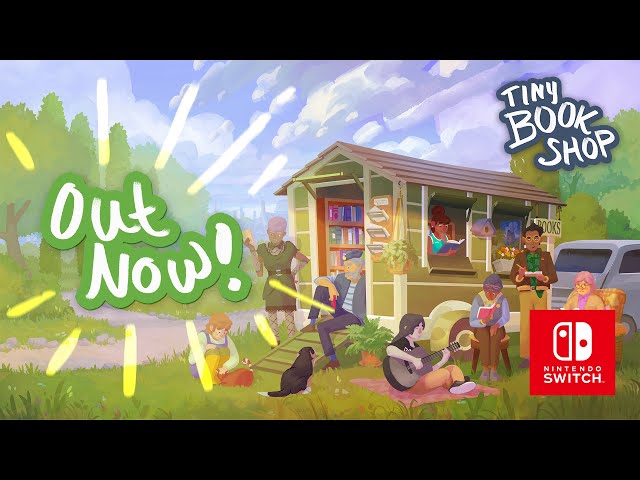
We’re so glad the game came to Switch – it’s perfect for the handheld system. How come the reveal came on release day? Was this to line it up with the Indie World presentation?
We announced our Steam release date quite early in May. The Indie World came later, and we’re really lucky the dates and times lined up so well, because for the longest time, we too didn’t know when the Switch release would be.
Lastly, I must know – what are your favorite books?
David: You’ll have seen a couple of them in Tiny Bookshop: Dark Places (anything Gillian Flynn really), Gregor the Overlander, the “A Song of Ice and Fire” series, and If We Were Villains are some of my all-time favorites.
There you have it, a look into the wholesome world of Tiny Bookshop. And some great book recommendations – I agree with the Game of Thrones series (if it ever gets finished). This is absolutely one of our favorite indie games, and definitely one of the best cozy games we’ve ever played – if you’ve not picked it up yet, what are you waiting for?