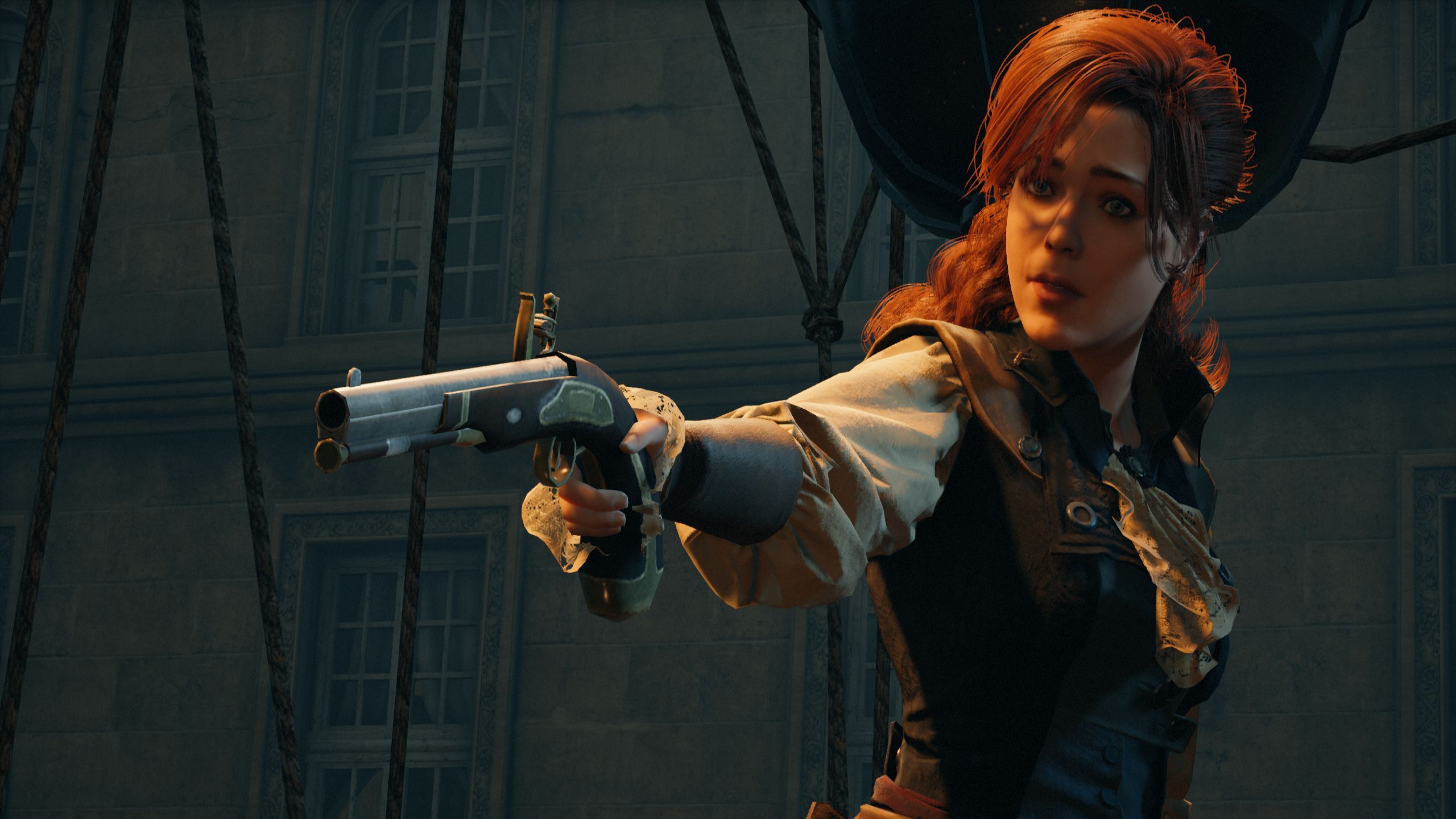
You’ve just completed one of Unity’s black box assassination missions, an infiltration with multiple diversions and entrances to find and exploit. The next mission has you meet up with Elise, your templar girlfriend, on the streets of revolutionary Paris. She’s being pursued by a mob of templar thugs—her faction aren’t fans of her or you at this point in the story—and you get roped into the chase. Literally. Her escape route leads to a demonstration of a hot-air balloon, the same model the Montgolfier brothers used just nine years previous in the first manned balloon flight. Of course, she jumps in. It’s your job to cut the ropes while fighting off the first wave of pursuers.
It’s a perfect setup for the kind of over-the-top pseudo-historical hijinks the Assassin’s Creed games specialize in. This is Ezio piloting Leonardo da Vinci’s prototype tank, or Lydia Frye shooting down biplanes over London with an experimental anti-aircraft gun. The Montgolfier springs into the air with Elise in it, but not you. You have to parkour after it while Elise leans out to shoot snipers. When the Montgolfier gets tangled on a rooftop you cut it loose, with just enough time for a dramatic leap into the basket and a romantic moment as the wind whisks you far away from the chaos of Paris in 1792.
In my last playthrough I saw a few NPCs hover off the ground, it’s still a crapshoot whether you can hand in the sidequest to collect all the pieces of the guillotine, and flickering white lines appear if you use TXAA, but otherwise it runs well—better than most of the open world games I’ve played recently. They even patched out the requirement to engage with a mobile app so you can open the blue treasure chests, which was an infuriating bit of “second screen experience” madness at the time.
Play it today, and Assassin’s Creed Unity is a reminder of what the series can be when it focuses on a single city. You can tidily wrap up Unity and its expansion Dead Kings in 40 hours without rushing. By contrast, you’ll need that much time for just Valhalla’s DLC, and nearly 100 more hours for the actual game.
Unity is about Paris—with brief excursions to Franciade and Versailles—and that means it can do Paris justice. The city looks like a painting by Nicolas-Jean-Baptiste Raguenet, all blue roof tiles and boats on the Seine, and when you freeclimb down to street level (downwards parkour being a Unity innovation) then you realize, merde, that’s a lot of people.
Unity’s crowds are something you don’t see in other videogames. There are mobs of people burning effigies and waving flags or pikes with heads on them, dancing, drinking, proffering leaflets, stretching their arms for a garment-fitting outside the boutique, propositioning sex workers, arguing about politics, and singing La Marseillaise everywhere you go.
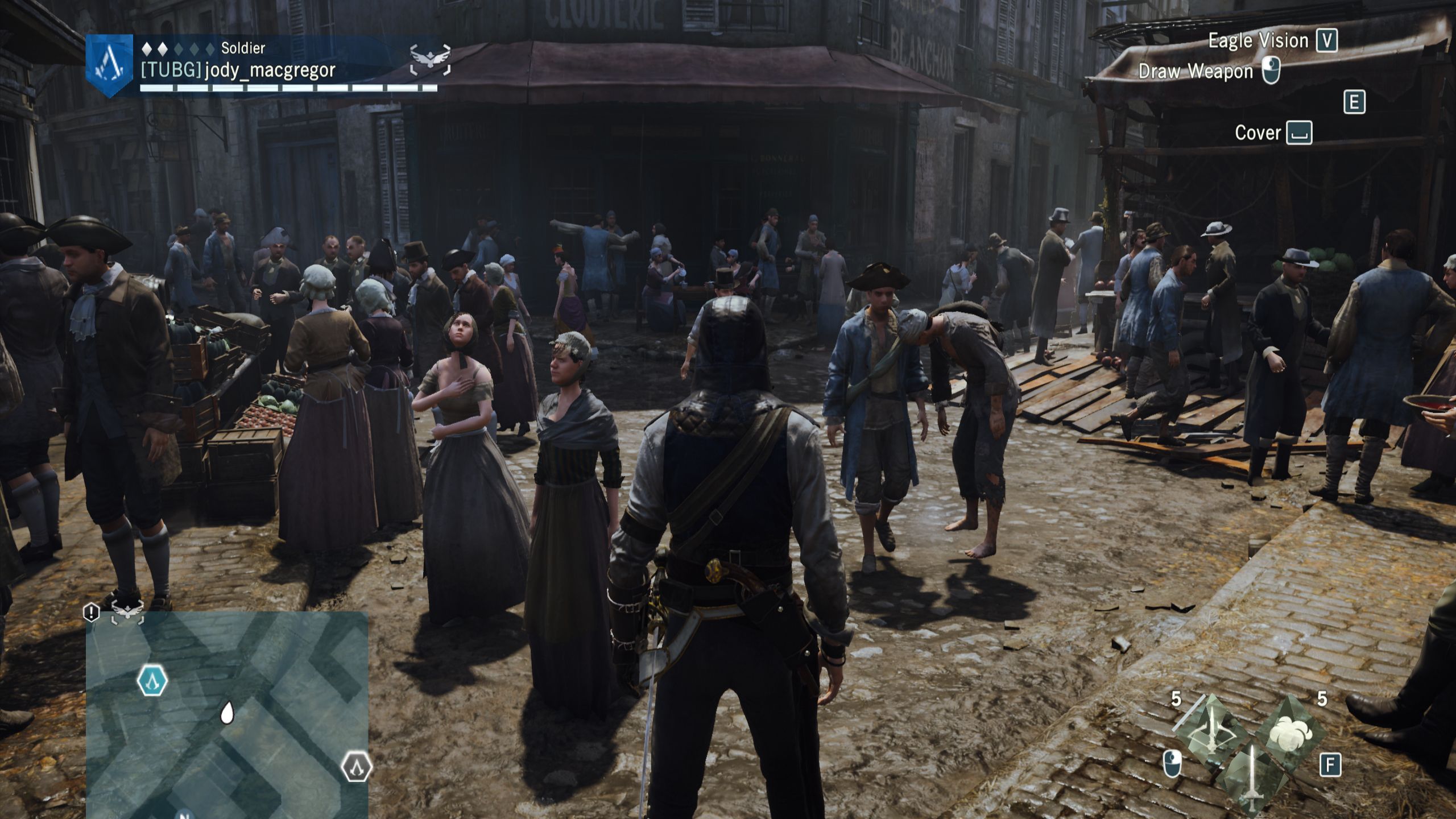
Thanks to Casablanca I can’t hear La Marseillaise without having an emotional reaction. I don’t care that some of Unity’s early missions take place in 1791 and La Marseillaise was written in 1792, any time I’m walking the streets of Paris and I hear it start up I feel a wild swell of national pride for a country I have no relation to, and love for a city I spent a nice afternoon in once. Le jour de gloire est arrivé!
If you get sick of the revolution, you can jump in a rift and travel to a different time period. I’m pretty sure the the rifts exist as an excuse to let you climb the Eiffel Tower, which was built to mark the 100-year anniversary of the revolution and would be an anachronism too far even for Ubisoft, but they’re also a replacement for the modern-day stuff the Assassin’s Creed series outgrew long before Ubisoft finally ditched it.
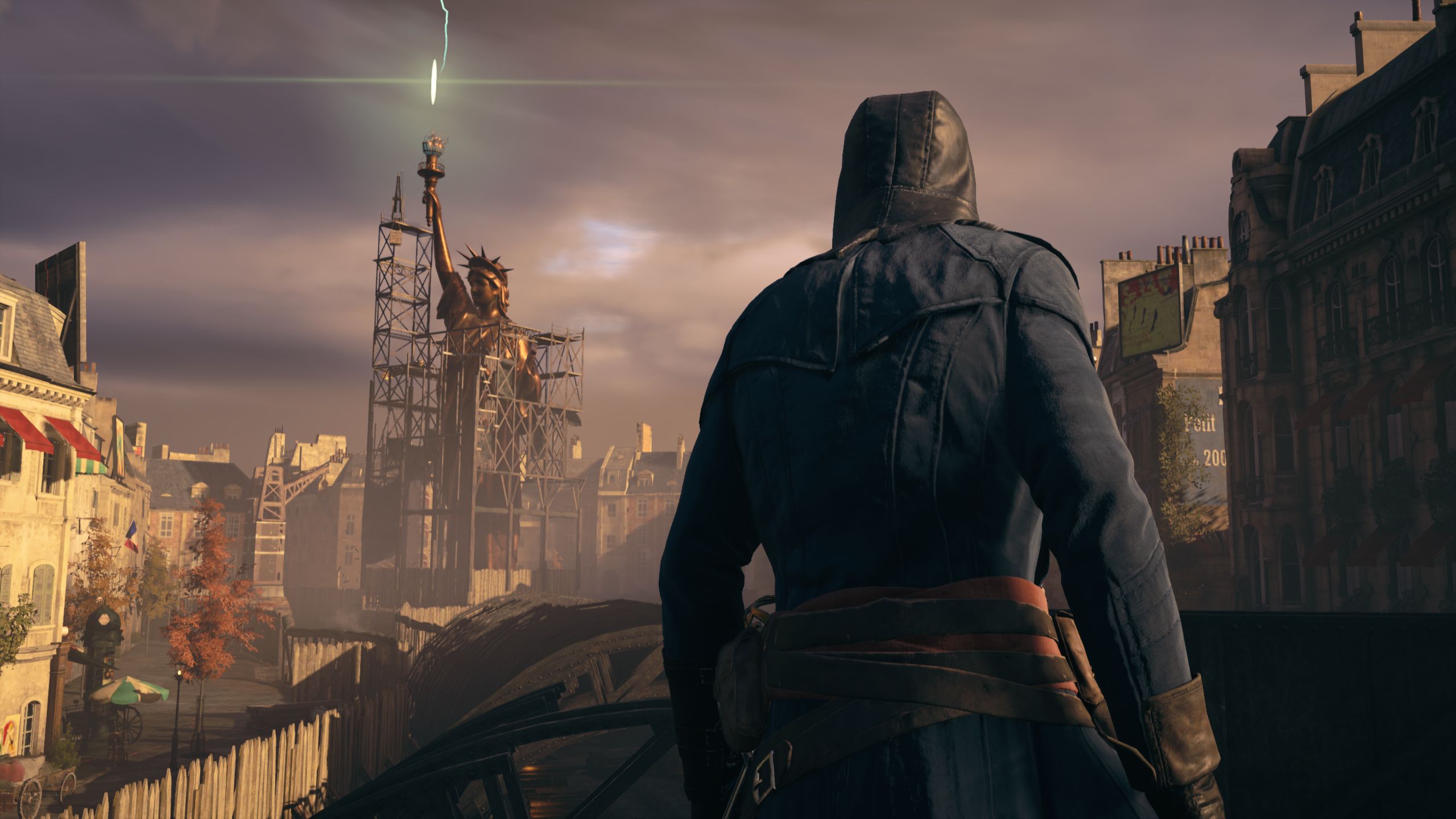
Instead of bouncing out of the simulation to spend time with that boring Desmond dude, you bounce around inside the simulation to a jumbled and glitchy Belle Epoque version of Paris with the Statue of Liberty in it, and of course you ascend that too. Which is neat, though nothing beats hopping to occupied Vichy France in the 1940s to parkour up the Eiffel Tower while being shot at by German planes.
Between the spectacle setpieces and the Paris sandbox are actual stealth missions. Unity was the first Assassin’s Creed game to have a crouch button, which is the central tenet of my argument that it’s the first actual stealth game in the series. It’s also the one that added separate controls for freerunning up and down, and one of the few that trusted you with a wealth of tools quickly accessible on the number keys (like Black Flag), making truly wild feats of skill possible.
![[AC Unity] Hoarders | Full Sync Stealth Reaper - YouTube](https://img.youtube.com/vi/909Zc-9VG7k/maxresdefault.jpg)
Watch On
It also made combat harder, with the automatic melee counter swapped for a parry that you need to follow up with a riposte yourself, and bullets that can drop you in no time flat. You feel fragile in a way that’s valuable in a real stealth game, that makes you actually want to engage with semi-obscure mechanics like using berserk blades to immobilize guards just long enough to get a stealth kill in—useful if you run out of phantom blades—or ducking just to bring up enemies on the minimap, or throwing smoke bombs at enemies instead of yourself then using eagle vision to pick them out of the cloud for a projectile kill.
Assassin’s Creed Unity released in 2014, and received a trial by social media like Mass Effect 3 had two years before, which outlasted any actual impressions of the game. The complaints about its shonkiness and lack of playable women in co-op were valid, but play it today and it holds up better than a lot of other Assassin’s Creed games do. Still, the crowd bayed for blood and off came its head—leaving just the teeth and eyeballs.