A Deckbuilder That is More Unrefined Than Slay the Spire 2 and Mewgenics, but Just as Clever
I’m slightly in awe of Mori Carta. Its pitch is reasonably simple – what would a Slay the Spire/Monster Train deckbuilder be like if you only had binary choices: to swipe left or swipe right? It’s Reigns (or Tinder) extrapolated to a roguelike deckbuilder. But I’m in awe of how completely it dedicates itself to that task. It could have been something fun but flippant; instead it’s as exhaustive, deep and astonishingly clever as any Mewgenics or Slay the Spire 2.
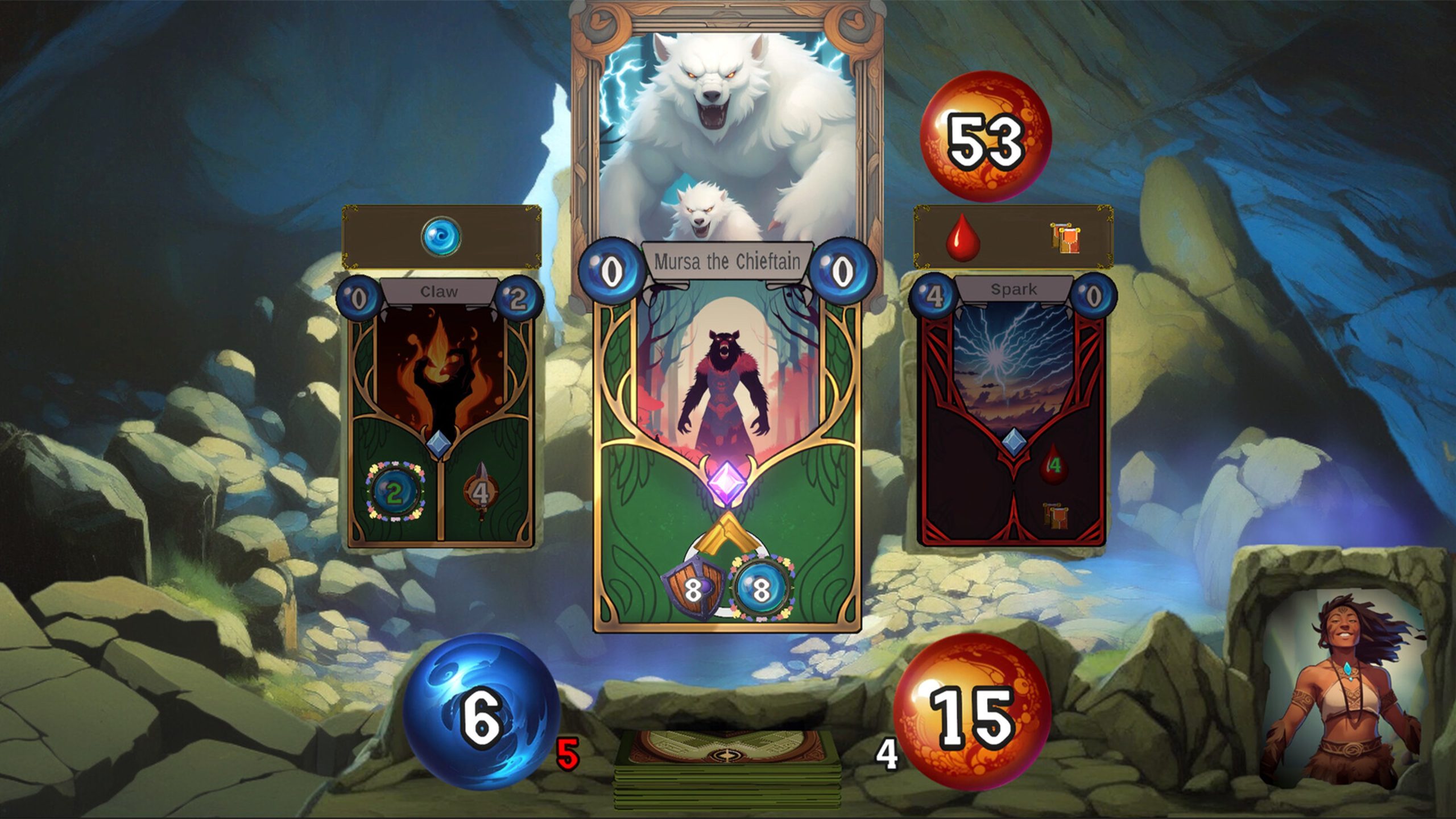
The cards in Mori Carta have two halves: a left half and a right. If you move the card to the left, the left effect triggers. Move it to the right and the right effect triggers. This is never as simple as it is with the starter cards: you might be able to generate mana for playing cards by going left, or applying armour to your character by swiping right. Which is more important to you and your deck right now?

A Game of Two Halves
Nevergreen Games starts to introduce wrinkles almost immediately. Each half of a card has a different mana cost, so you won’t always be able to pay for the better effects. So you have to set yourself up: building mana reserves in case your best card happens to drift towards the top of the deck. Mana persists with each shuffle of the deck, while effects like armour do not.
It’s not only your cards that make up your deck. Enemies tend to slot some debilitating cards into your deck while you’re not looking. At the start of the game, they tend to be a simple proposition: if you pay a bit of mana, you won’t get damaged. But they soon get more problematic. Howsabout if you don’t pay, the card gets duplicated? Or it forces you to discard your next few cards? It’s entirely possible to be in a horrifying situation where your deck is full of enemy cards, and you don’t have the means to thin them out.
Balance your game and deck, and you may well reduce an enemy’s health to zero while not incurring too much damage yourself. Which leads to Mori Carta’s rewards, and where its genius tends to reside. Because Mori Carta really commits to the whole binary choice thing: you can pick from left reward or right reward. That choice might be simple, like a choice between two uncommon cards or one rare card, or attack flavoured cards versus defend. But it can be as tough as choosing between a rare or a ‘Split’ reward.
Always take the Split Reward: you will Thank us Later
Ah, the Split. It is, hands down, my favourite thing about Mori Carta. You can take a pair of scissors to the middle of one of your cards. Now, instead of choosing between two very good options in a game, you can have both of them as independent cards in your deck. Got a card that has a negative effect on one half? Split it, and then ditch the bad effect later on. Pruning your deck has never felt quite so much like you are actively pruning.
Mori Carta starts with the Scholar character, who focuses on ‘upgrading’ her cards. Belay a card’s attack, armour or mana generation and the card will increase in effect, so you will get a greater number of those things on the subsequent turn. Even better, whenever you upgrade a card, you get to pocket two mana. Scholar is a player of the long-game, and – by a significant margin – the easier class to grasp, so it’s clear why it’s the default.
But complete the game once with the Scholar and you unlock the Trickster, Druid and Atoned. It blows me away that no card – not a single one – is shared between these characters. Playing them is a completely different experience, and there are dozens of cards to unlock for each. I am still earning the odd remaining few cards (I’m sorry Trickster, I haven’t quite succumbed to your odd tempo).

Phoning in my Atoned Run
Atoned is my favourite, possibly because I can shut my brain down and just let the combos build. She deals in ‘Faith’, which is a keyword that builds and builds as long as you stay one-sided. Get ten Faith by moving ten cards to the right in sequence, and you can cash that Faith in for ten damage, ten energy or more. Druid is probably in our second place, as she can ‘paint’ the left or right side with a sword, shield or mana, and any card with that symbol finds its effect doubled. That’s neat for when you want to spike damage – plus she has loads of cute bears on her cards.
It’s sad that whenever I see art in a video game, I have to question whether it’s AI or not. But, assuming it is not AI-generated in Mori Carta, the illustrations are quite lovely. They are grand landscapes destroyed by earthquakes and magma, or quirky fae creatures. Considering just how many hundreds of cards are in the game – and how many have two or three variants, considering they can be upgraded and downgraded – the art seems like a monumental achievement.
Elsewhere, the presentation is a little to be desired. Mori Carta can’t afford to be as lavish as some of the bigger hitters in the genre, and it shows. Some parts of the HUD simply aren’t clear or explained (there are lots of orbs and numbers, but the assets are often shared between them all, confusing a new player). It took me a while to learn what the numbers meant below my deck, where my mana was, and what certain icons meant.
Hard to Learn, Slightly Less Hard to Master
There is a high ceiling and an equally high floor to Mori Carta. I’m not convinced that the tutorial is adequate, and I mostly learned through persistence and a bit of borrowed knowledge from similar games. There are a LOT of cards to get familiar with, and you can earn as many as three of them in a single reward haul, which means that decks get unwieldy quickly. And enemies are all wildly different from each other: they have their own special rules, and it’s incredibly easy to make one or two mistakes (having misunderstood what they do) only to find your roguelike run is now effectively over. Mori Carta punishes you if you don’t grasp the enemies almost immediately.
But, of course, you can git gud. Which leads to another lack of polish. I am unconvinced with the balance in Mori Carta. There are particular combinations of cards that can make you unbeatable. When playing the Scholar, I have to stop myself from defaulting to a combo that gives me an unholy amount of mana generation and then spends it all on a massive attack. They both exhaust (remove from the deck once used), but if I can make them both ‘Quick’ (a reward that moves them to the top of the deck) I can kill any creature with less than 100 health in the first two cards. Which is about 80% of creatures.
There are variations on these infinites and problematic combos. I’ve had an Atoned run where every card I played was duplicated, but I also had a ‘Quick’ phoenix card that would shuffle my deck. So I would play all my Quick cards, duplicate them, then shuffle the deck to get them back again, but duplicated. I never had to encounter an enemy card. Which, again, made me chuckle, but robbed the game of any friction. If these effects needed several cards to trigger then it might have been fine, but I only needed two.

Should you Swipe Left or Right on Mori Carta?
If I were to characterise Mori Carta, it’s a big gem of a roguelike deckbuilder. It’s multi-faceted and cavernous, and I could get lost in it for evening after evening. I’ve still not earned every achievement and gained every card, but I have every intention of doing exactly that.
But, as a gem, it’s a rough one. The presentation is lacking in places; the tutorial doesn’t help out a starting player; and the balance is so out of whack that you can have runs where the enemy doesn’t even touch you. It’s hard to learn and hard to master, but with the occasional combo that makes it ludicrously easy.
If you’re a deckbuilder fan of any kind, I’d recommend Mori Carta in a heartbeat. Initially, it’s a little hard to love, but persist and embrace the left-right mechanics and you will be rewarded with a majestically clever and rewarding card game. If you’re new to the genre, though, there are much more welcoming (and balanced) places to start.
Regardless of who you are, what a year it has been for deckbuilders. Slay the Spire 2, Mewgenics and now Mori Carta. We card game fans are eating well.
Important Links
Mori Carta Wants To Reinvent Deckbuilding – https://www.thexboxhub.com/mori-carta-wants-to-reinvent-deckbuilding/
Buy from the Xbox Store – https://www.xbox.com/en-gb/games/store/mori-carta/9NQJ20G5HXT6