Weird Weekend
Weird Weekend is our regular Saturday feature where we celebrate PC gaming oddities: peculiar games, strange bits of trivia, forgotten history. Pop back every weekend to find out what Jeremy, Josh and Rick have become obsessed with this time, whether it’s the canon height of Thief’s Garrett or that time someone in the Vatican pirated Football Manager.
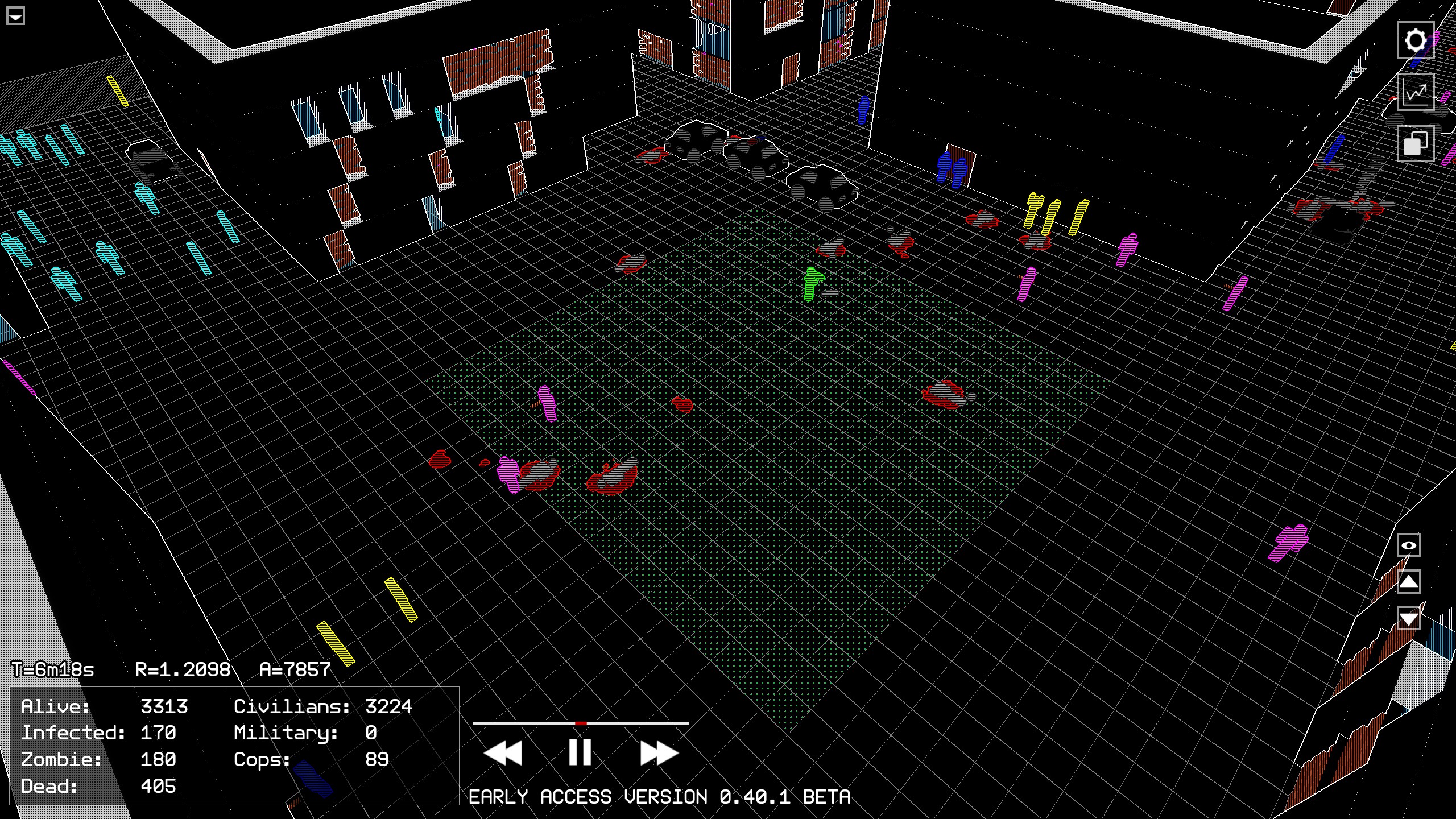
In hindsight, calling my new town—in outbreak simulator DeadOS—Zombieville was a rubbish idea. Not only because it’s a terrible name for a town, but also because Zombieville completely failed to live up to its name.
See, I’d cooked up a properly nasty pathogen for my nominally determined settlement, the kind that makes 28 Days Later’s Rage virus look like a bad cold. It transmitted instantly, converted the victim almost as fast, and produced zombies that could move twice as quickly as the average human.
If this thing got out into the streets, humanity would be dead in days. At least, that’s what I thought as patient zero Ruby Mancini picked up the virus at an inner-city intersection (cause unspecified, but let’s say ‘bat burrito’). After turning a gnarly shade of green, Ruby was primed to chow down on her fellow pedestrians. But she had barely taken a step before being run over by a car.

Ruby’s premature un-death taught me an important lesson: it’s surprisingly hard to get a good zombie apocalypse going. And it isn’t the only thing I learned from DeadOS, a simulator dedicated to the part of zombie fiction that most games gloss over.
DeadOS is the creation of Benn Powell, an indie game developer who you might know for his Randomizer mods for the Resident Evil series. Indeed, it was Resident Evil, specifically Resident Evil 3, that formed the inspiration for DeadOS:
I really wanted to make a game that focussed on that specific part, the part that never makes it into a game.
Benn Powell
“There’s a cutscene right at the beginning where they show the helicopter flying over, all the people getting eaten and dying, and the police coming out and doing their bit,” Powell says. “Then everybody’s dead and the game starts. I really wanted to make a game that focussed on that specific part, the part that never makes it into a game but is always in a cutscene.”
Powell began designing DeadOS in 2019 just before the Covid-19 pandemic—which actually influenced the direction of the game. “It taught me about the R rate … which I think [stands for] reinfection rate,” he says. “Now, when you run DeadOS, it tells you the ratio of how many people each zombie infects, so if that number is above one, you have an exponential zombie infection.”
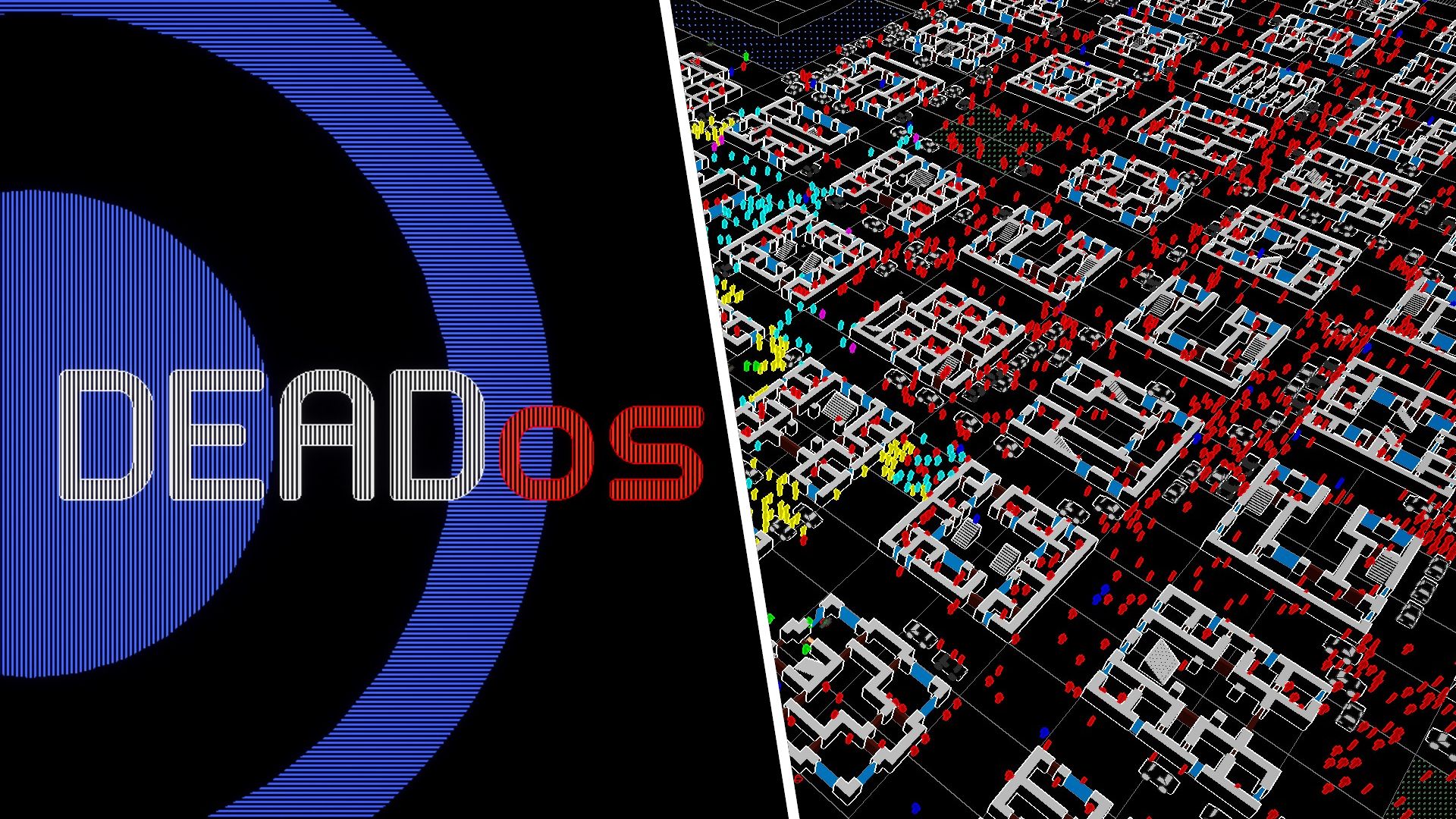
Calling DeadOS a game is not strictly accurate. It’s more of a simulation sandbox, one that depicts the spread of a zombie apocalypse across a procedurally generated 3D cityscape. You’re not so much trying to achieve a specific goal as seeing what happens when you push this button.
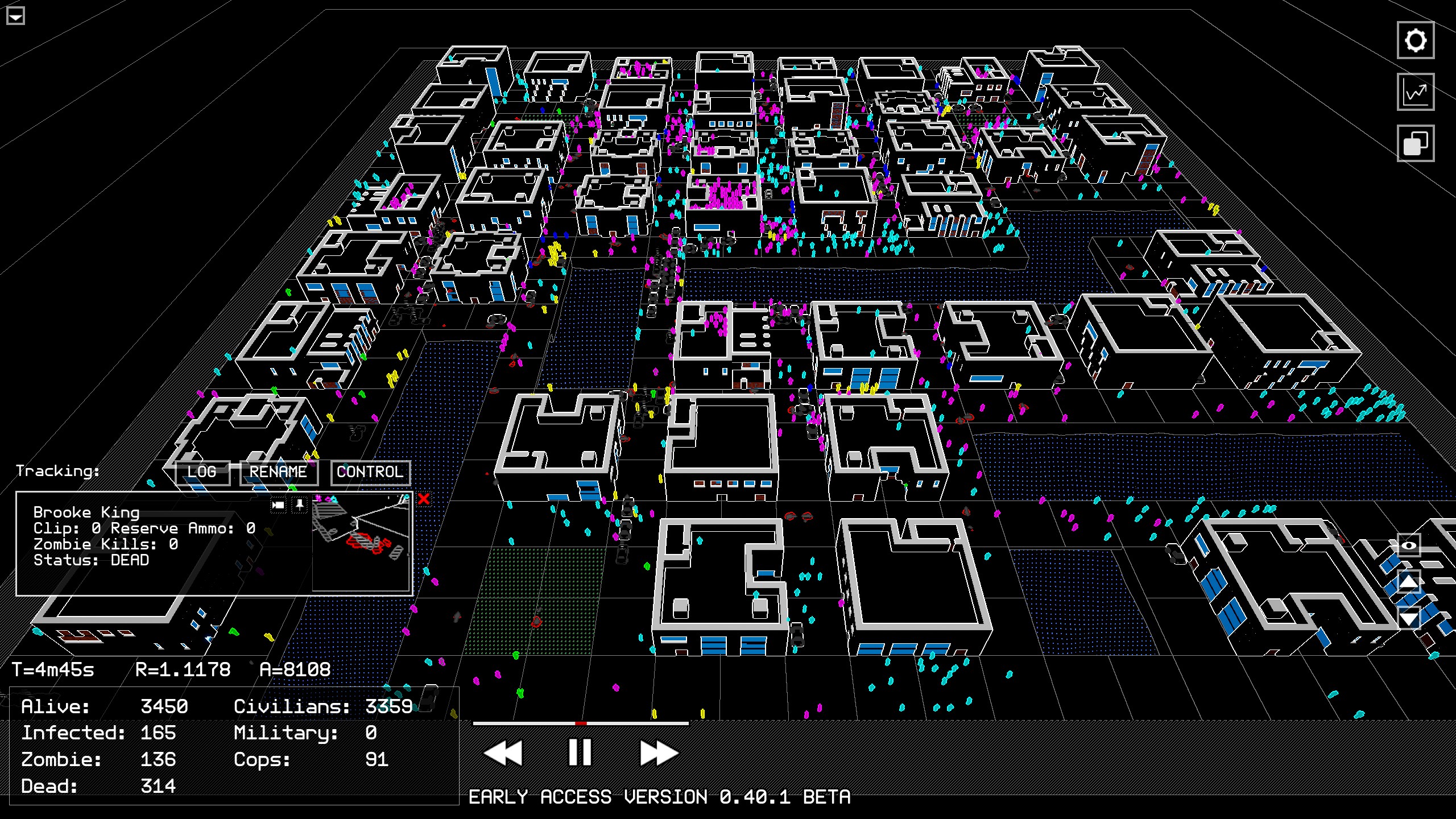
DeadOS lets you set a wide range of parameters: the size of the city, its population, the number of armed citizens, the number of police, how easily the virus spreads, what kind of zombie it creates when it does. Then you click ‘play’ and watch the results of that setup play out.
As a highly goal-oriented player, DeadOS isn’t the kind of experience that would normally appeal to me. But I find its simulation fascinating, because it raises some interesting questions about how a zombie apocalypse might play out. The biggest is the one I mentioned earlier—the surprising challenge of successfully seeding a zombie epidemic.
Initially, DeadOS was a simple simulation of how an infection spreads through a population. A zombie would bite a person, that person would get infected and eventually die. Then they’d rise as a zombie and bite another person, so on and so forth. But things changed dramatically once Powell started adding things like weapons and police.
“When I first added guns, [people] would see a zombie and go ‘Zombie!’ and then blam blam blam!” he says. But since not everyone has the discipline of a Tier 1 Operative, Powell added the possibility for people to hesitate or panic. “You have to have that bit in Resident Evil 2, with the cutscene where Leon’s like ‘Don’t come any closer, I’m gonna shoot!'”
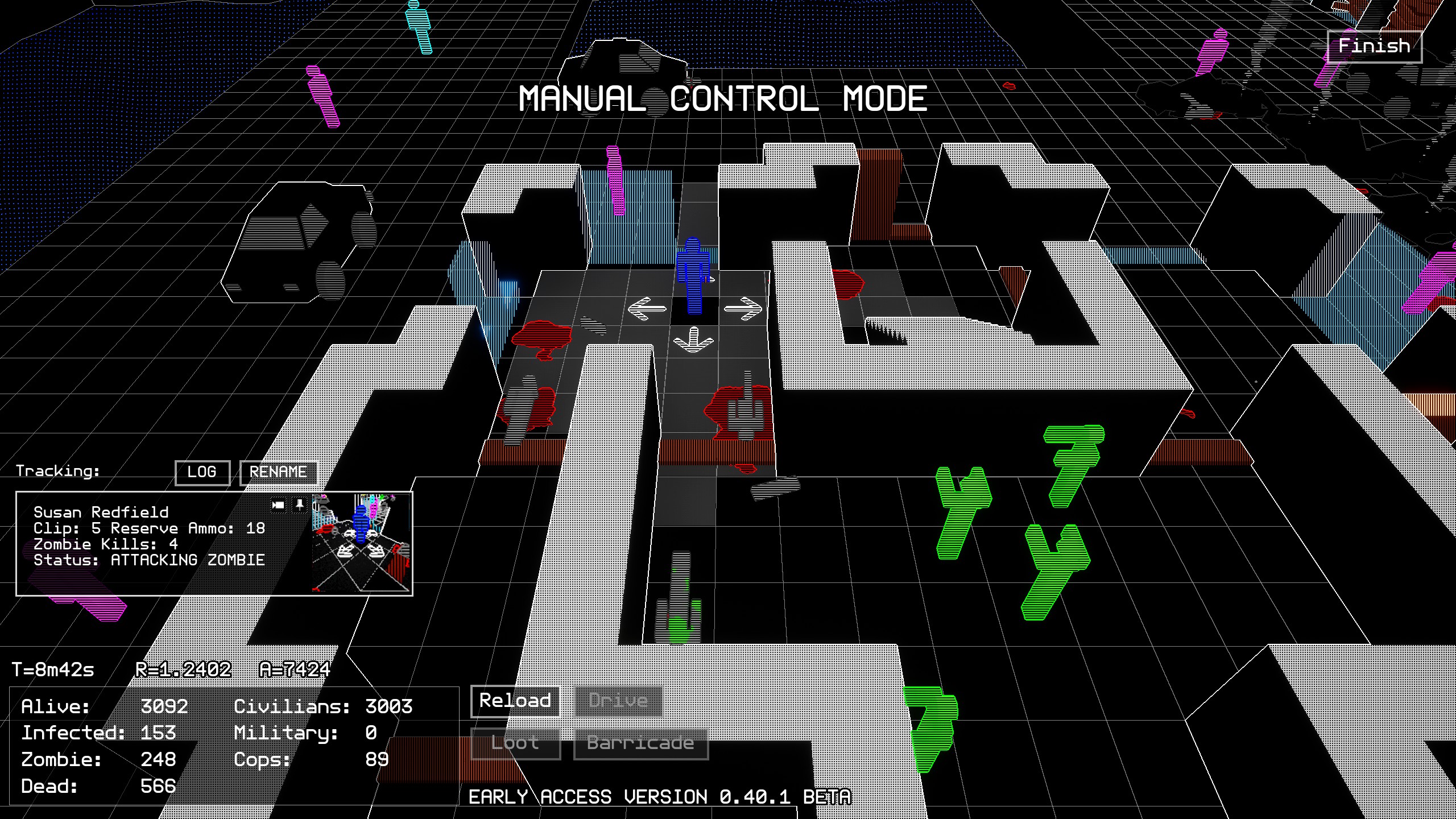
Even with the human factor considered, getting a zombie virus to spread through a civilian population is surprisingly hard, especially in a patient zero scenario where the epidemic starts with a single, traditional slow undead. “If you just let the simulation run, it will fail, because it’s just one [zombie],” he says. “All the people run away from it, and it will shuffle around until the police turn up.”
Braver people will fight the infection more, but then they’ll also die more.
Benn Powell
Generally speaking, the infection needs a little help. The default play mode—which generates all the parameters for you—solves this problem by having the infection start from multiple points at the same time. “If it’s in one place everyone can surround it, they can push everyone out of it, they swarm the area. It’s probably not going to get out of there,” he says. “When you have two outbreaks at once, and then people start fleeing from one encounter to another … that’s how people get killed—they get trapped between two groups of zombies.”
But there are other factors that can give the infection a boost too. In particular, the speed of the zombies has a huge effect on the spread of infection. With apologies to classic zombie fans, 28 Days Later-style infected are simply much more lethal than traditional shamblers. “They [can] go as fast or faster than people,” Powell said. “Then you can get closer to having the patient zero scenario … especially if you make [people’] turn fast as well.”
DeadOS also reveals some interesting observations about human behaviour too. “Braver people will fight the infection more, but then they’ll also die more,” Powell says. Also, perhaps unsurprisingly, carrying a gun makes civilians much more likely to survive a zombie outbreak. So is the best way to survive a zombie outbreak to be a massive coward with a gun? That’s what DeadOS suggests.
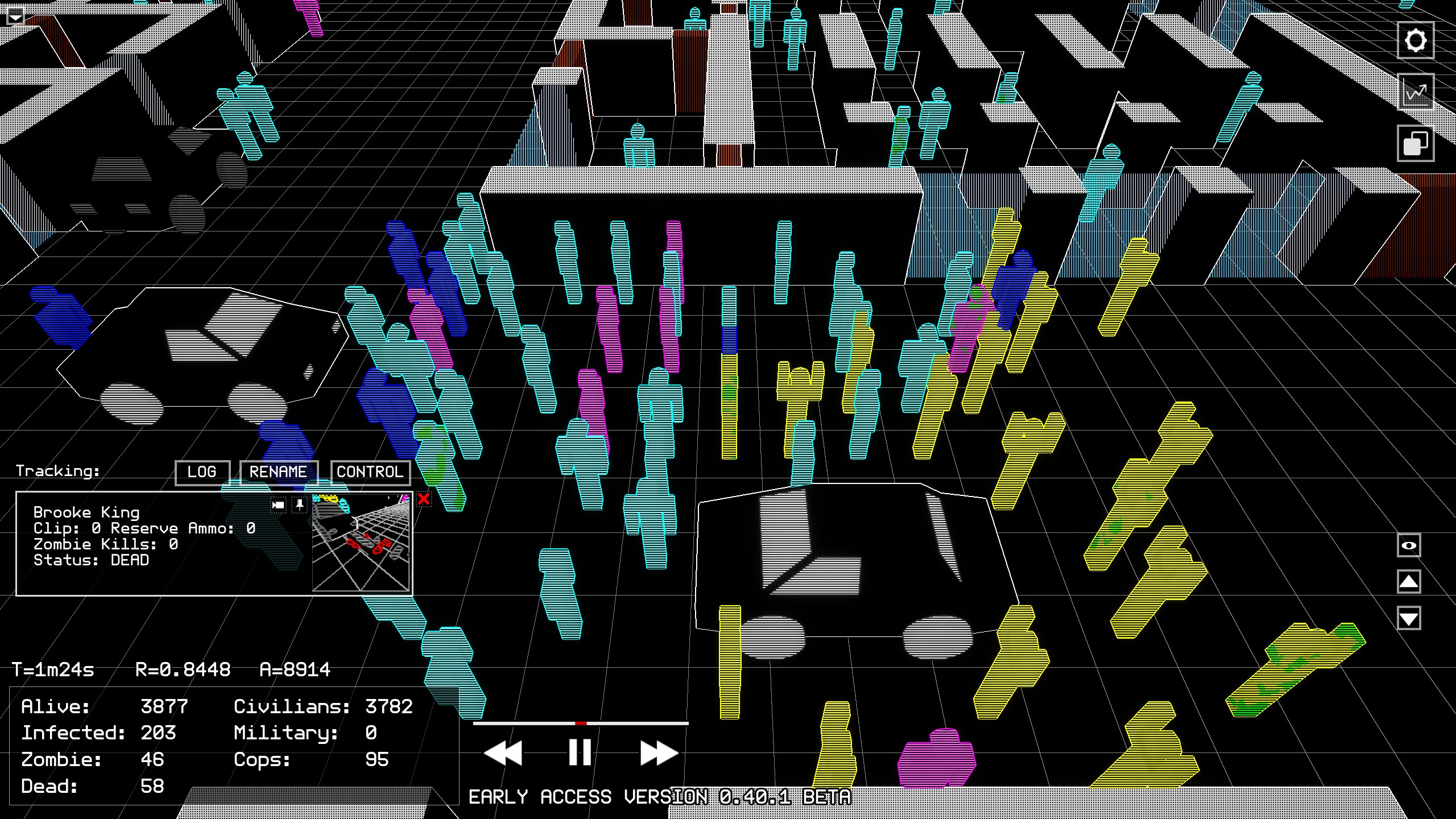
Ultimately, Powell says that in a population of 4,000, 250 traditional zombies will be sufficient to make the spread of infection difficult to contain without intervention. At this point, it’s really up to you how you let the simulation play out from there. You can simply sit back and watch what happens. Or you can take control of a specific NPC and try to guide them through the scenario, fighting zombies, putting up barricades, looting corpses for ammunition. DeadOS is actually a turn-based game, but when the simulation is running, the turns happen so fast that it appears to be playing in real-time.
And if you grow tired of zombies tearing up the joint, you can decide to call in the military. This is one of the few direct actions players can take during the simulation. When called in, the military arrives in helicopters, deploying squads across the city and sweeping it systematically. It’s pretty neat to watch.
DeadOS has been in development for close to seven years, and in Steam early access for almost five years. Yet Powell has no plans to stop making it any time soon. “I want people to be able to make their own cities … so people can purposely design an entire city. I want put in Steam Workshop support, so people can say ‘These are my cities’ or ‘We’ve remade London.'” He also plans to add other institutions like hospitals, and a proper quarantining system for the military.
The end goal for Powell is to make the most detailed zombie outbreak sim he can with the resources available to him—the Dwarf Fortress of undead Armageddon. “I can’t think of another game like this,” he concludes. “That’s my motivation. This is unique. It’s the game I wanted to play but couldn’t because it didn’t exist, so I made it.”