Sometimes it’s easy to forget that I’m supposed to review games. As the industry drives itself straight off a cliff like a drunk driver listening to a faulty GPS, and the summer drought kicks in, leaving us bereft of games, I’ve been so busy writing news that review work has fallen by the wayside.
But here we are, back in the saddle. Well, in a drone, anyway.
Iron Guard: Day Zero is a tower-defence strategy game, a genre I only occasionally dabble in but still deeply enjoy. It is essentially a rebuilt flat-screen adaptation of the original Iron Guard VR, designed both as a more accessible PS5 version and as a gateway into Xlab Digital’s VR-born tower-defence series. It is not really Iron Guard 3, nor is it a straight untouched port. It is the original VR game dragged out of the headset, scrubbed up, taught how to use a DualSense, and sent into the wider PS5 world to see if anyone outside the VR bubble is paying attention. It’s a little….er, confusing, really.
Available On: PS5
Reviewed On: PS5
Developed By: Xlab Digital
Published By: Xlab DigitalReview code provided by the publisher.
Iron Guard: Day Zero’s plot is fairly simple. Your ship has crash-landed on a planet inhabited only by terraformers. For some reason, the planet appears to have been abandoned. There are buildings, roads, and an entire network of infrastructure, but no humans using any of it. Nobody’s milling about wondering where the nearest Starbucks is, or complaining loudly that this corner’s McDonald’s isn’t quite as good as the other corner’s McDonald’s.
Naturally, you quickly discover that the robots on this planet have gone batshit crazy and would very much like to kill you. Your goal is to survive 30 campaign levels via tower defence, which mostly means building whatever you can, wherever you’re allowed to, in order to hold off the onslaught.
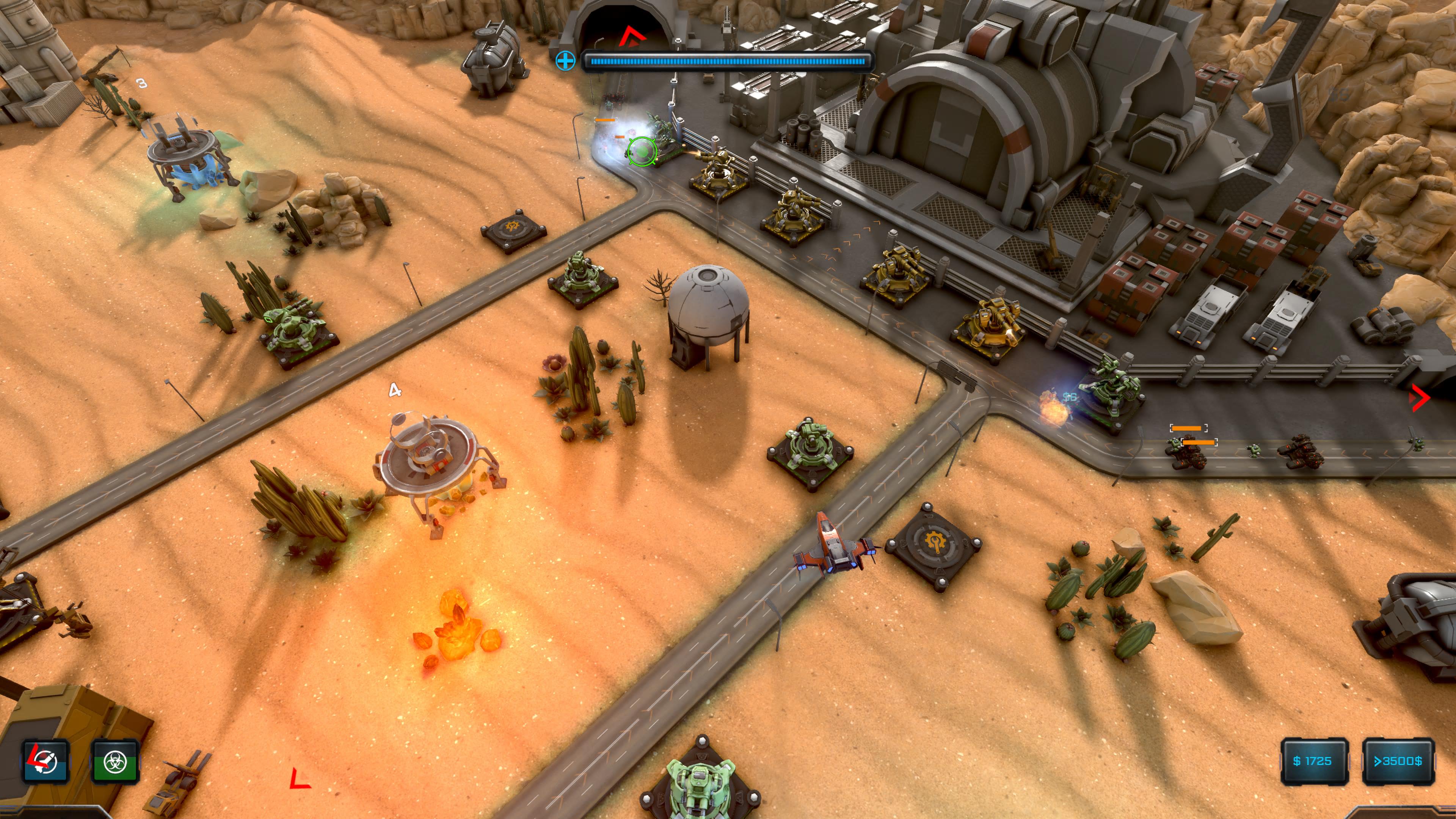
Story-wise, it’s all very forgettable. The game does its best, but the voice acting isn’t really up to snuff, often leaving characters sounding flat and monotone. That isn’t helped by the writing, which is equally flat and monotone. There’s not much I can say about it without sounding like an asshole: it’s forgettable. It does just about enough to justify why you’re stuck on this planet shooting robots, and that’s about it.
There are a couple of moments the game seems to view as twists, but they’re about as surprising as being told a large corporation doesn’t actually care about your individual happiness. Beyond that, there’s really not much else to say about the story.
Almost every level in Iron Guard: Day Zero follows the exact same template: defend your base. I mean, this is a tower-defense game, after all.
That means you’re given multiple routes leading toward your base, all peppered with building plots where you can deploy various turrets and defences to handle the onslaught of enemy drones and terraformers charging at you like metallic overlords who want to introduce your skull to the concept of AI directly.

Much like the real world, though, you need building permission before you can just slap things down, and even then, you can’t just put them wherever you bloody please. Turrets can only be placed on set points, so success comes from figuring out which defences to build, where to build them, and in what order. And to fund all these fancy devices, you need to reduce the incoming waves to little more than scrap metal.
The key to holding back the enemy onslaught is mixing your turrets properly. Electrical turrets are great for taking down shields and, most importantly, slowing enemies down. The standard cannon turret is usually best for dealing with large numbers of small, fast enemies, but once upgraded so it can also dish out some pretty hefty damage. Rocket turrets are the only things capable of handling flying enemies, so spreading them around liberally is very useful. The laser turret is mighty and powerful, but takes an age to reload, as if someone has to run out to the shop and buy a fresh pack of batteries every two seconds. The flamethrower, meanwhile, is best used for dealing long-term damage, which means it usually works best near the start of your defences where it has time to really take effect.
Iron Guard: Day Zero’s one real twist on the tower defence genre is that you control a drone in the sky using the two analogue sticks. With this drone, you fly around the battlefield, point at building plots, bring up a radial menu to decide what to construct, and voilà, turrets are built. You can upgrade them using the same method, and you can also build resource extractors, which we’ll come back to later.
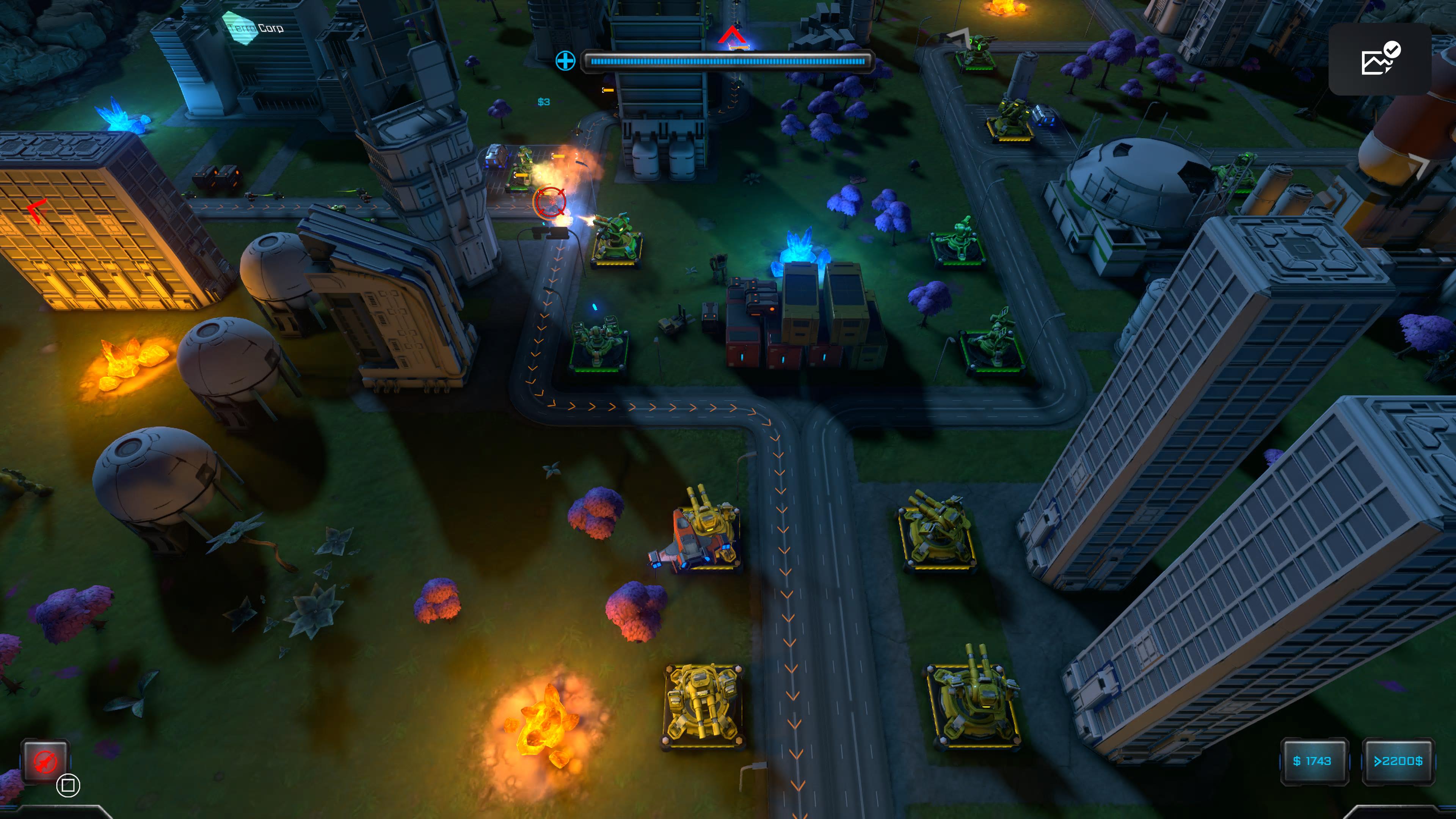
More importantly, though, you’re capable of involving yourself in the combat directly. Your drone has a fairly puny little laser gun that can be used to bombard the enemy drones and terraformers. It does an annoyingly small amount of damage, and yet, despite that, you can actually make a reasonable difference in the fight. You’ll often find yourself flying between the different lanes, trying to figure out where your extra firepower might be needed most. A secondary charge-up attack can also be useful for dealing with shielded enemies.
A few upgrades later on do make your drone feel more powerful, but at no point does it feel quite useful enough, which is weirdly at odds with the fact that you really can make a difference when using it. You can point at one enemy and hold down the trigger until the heat meter fills up and your gun stops firing, yet still feel like you’ve barely made a dent in its health bar. It’s an odd contrast, but there we have it.
Flying enemies don’t attack your base directly, but they do attack your drone, disabling your gun and special abilities. Those abilities are probably the most useful things your drone has: a chemical weapon that can be deployed on the battlefield to deal significant area damage over time, and an airstrike designed to blow the shit out of everything unlucky enough to be on the road beneath it. Both are effective, both are on timers, and both can be upgraded.
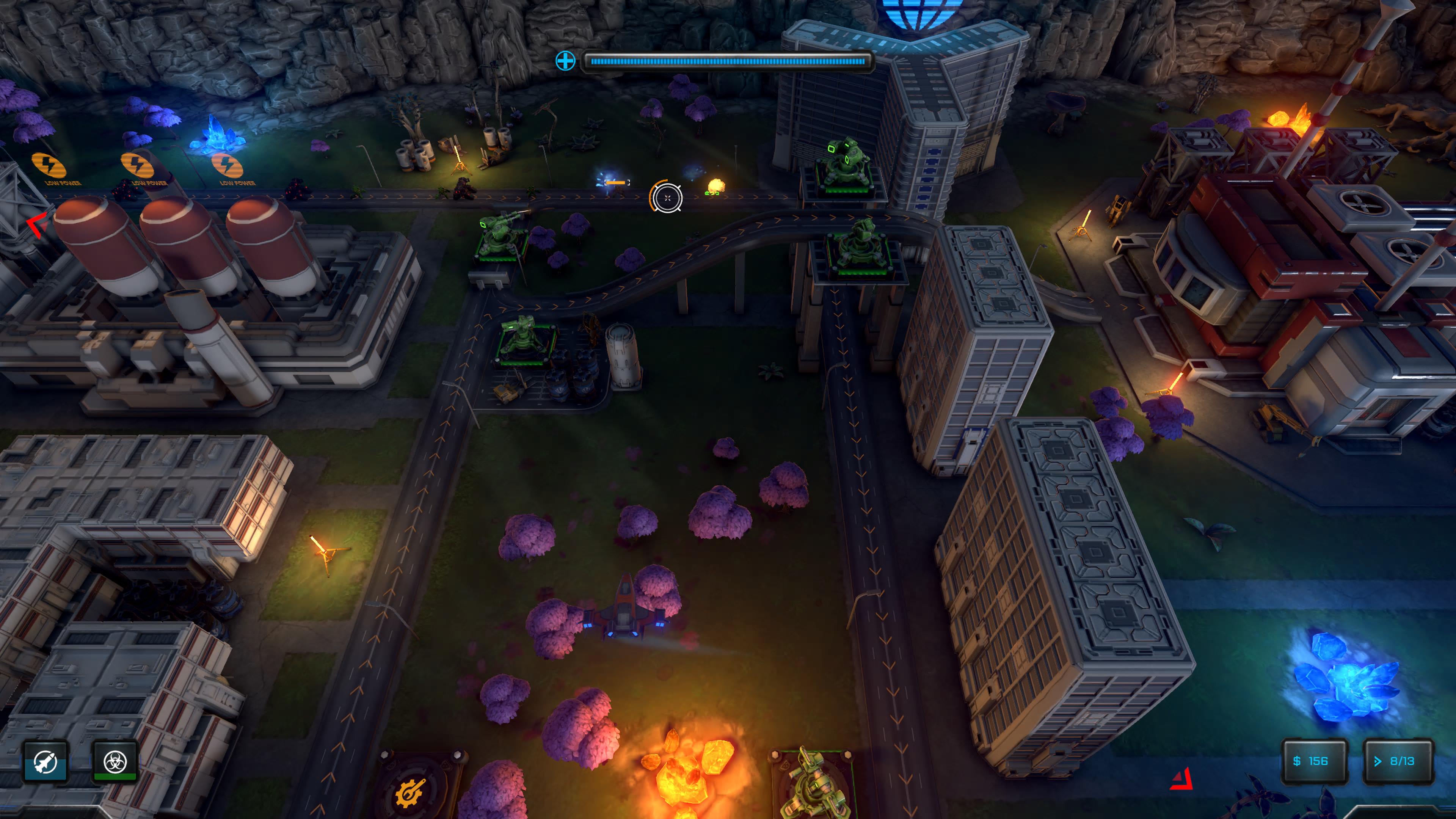
Some levels also feature blockers on the routes. Instead of having straight roads leading directly to your base, these maps are more complicated and allow you to spend a small amount of the resources earned from killing robots to raise blocker gates at set points. These redirect enemy routes, usually letting you make the path longer and force attackers past more defensive points.
I like this element. It’s an interesting strategic twist, even if I’m sure other tower defence games have done similar things before. Trying to figure out how best to fuck with enemy routes often feels more strategically interesting than deploying turrets, which can become fairly standard after a few rounds once you get the hang of what to combine and where to place them. Gradually figuring out how to send a batch of enemy units three extra kilometres around your city before they ever reach your base is satisfying.
Speaking of gameplay twists, Iron Guard: Day Zero does occasionally try to throw in something to spice things up. For example, one very late mission sees you defending allied buggies as they try to make it back to base. It’s an interesting game type, although admittedly this particular level uses the idea a little clumsily in a way that can feel unfair at times. I eventually muddled through, but it’s not the best showcase for the mechanic.

Other levels let you play for as long as you need because your goal is simply to acquire a certain amount of cash rather than survive a set number of waves. Others change the objective so that you’re defending until a progress bar reaches 100%. Usually, these are more like stat changes or UI changes than meaningful shake-ups. You’re still defending against waves and waiting for something to finish; it’s just that instead of counting down 12 waves, you’re watching a bar fill up.
Still, it’s nice that the game at least tries. Across the 30 campaign levels, though, it does feel like there was room for a few more interesting ideas to be added into the mix rather than leaning so heavily on straightforward tower defence.
Across the campaign, you’re awarded points at the end of each mission to spend on upgrades. These are mostly standard fare. Turrets can be improved so that you can buy newer, more advanced versions of them mid-level, alongside passive buffs that make each one more effective. Likewise, you can unlock things like the ability for your base to slowly repair itself, upgrades for your airstrike and corrosive weapon, improvements to resource mining, and a few other bits and pieces.

There’s enough variety here to make you feel like you have some small amount of control over your preferred playstyle and the direction of your defences, but ultimately not much. A few upgrades feel useful, a couple feel fairly pointless, and most sit comfortably in the middle as quietly helpful but unexciting additions.
In other words, the upgrade system is fine. It exists. It gives you something to spend points on between missions, but it doesn’t add much personality or depth to the experience.
There are a few other rough edges worth mentioning, too. Even on the easiest difficulty setting, a couple of levels caught me off guard with sudden difficulty spikes. Usually, this just meant replaying the mission once or twice to figure out the correct turret placement or route strategy, so it was more annoying than disastrous, but it does make the campaign feel a little uneven in places.
In Conclusion…
The problem Iron Guard: Day Zero faces is that without the VR gimmick, there isn’t a whole lot else left.
It’s not that the game is incompetent or outright bad. It isn’t. It’s a perfectly functional tower defence game. But without a headset strapped to my face and sweat pouring down my forehead, what am I really left with? Mostly, a bog-standard tower defence title that struggles to find anything memorable to call its own.
The drone you personally control does set it apart a little, letting you fly around the battlefield, build and upgrade turrets, and contribute directly to the fight. But it doesn’t set the game apart enough. Nor does the story do much to make things more interesting. What remains is a familiar selection of turrets, familiar enemy waves, familiar upgrade paths, and familiar tower defence problems that have been solved hundreds of times before by other games.
That leaves Day Zero in an awkward place. It’s not bad enough to be interestingly bad, nor distinctive enough to be genuinely exciting. It’s simply okay. A competent, playable, mostly forgettable tower defence game that probably made a lot more sense when its familiar ideas were being experienced from inside a VR headset.