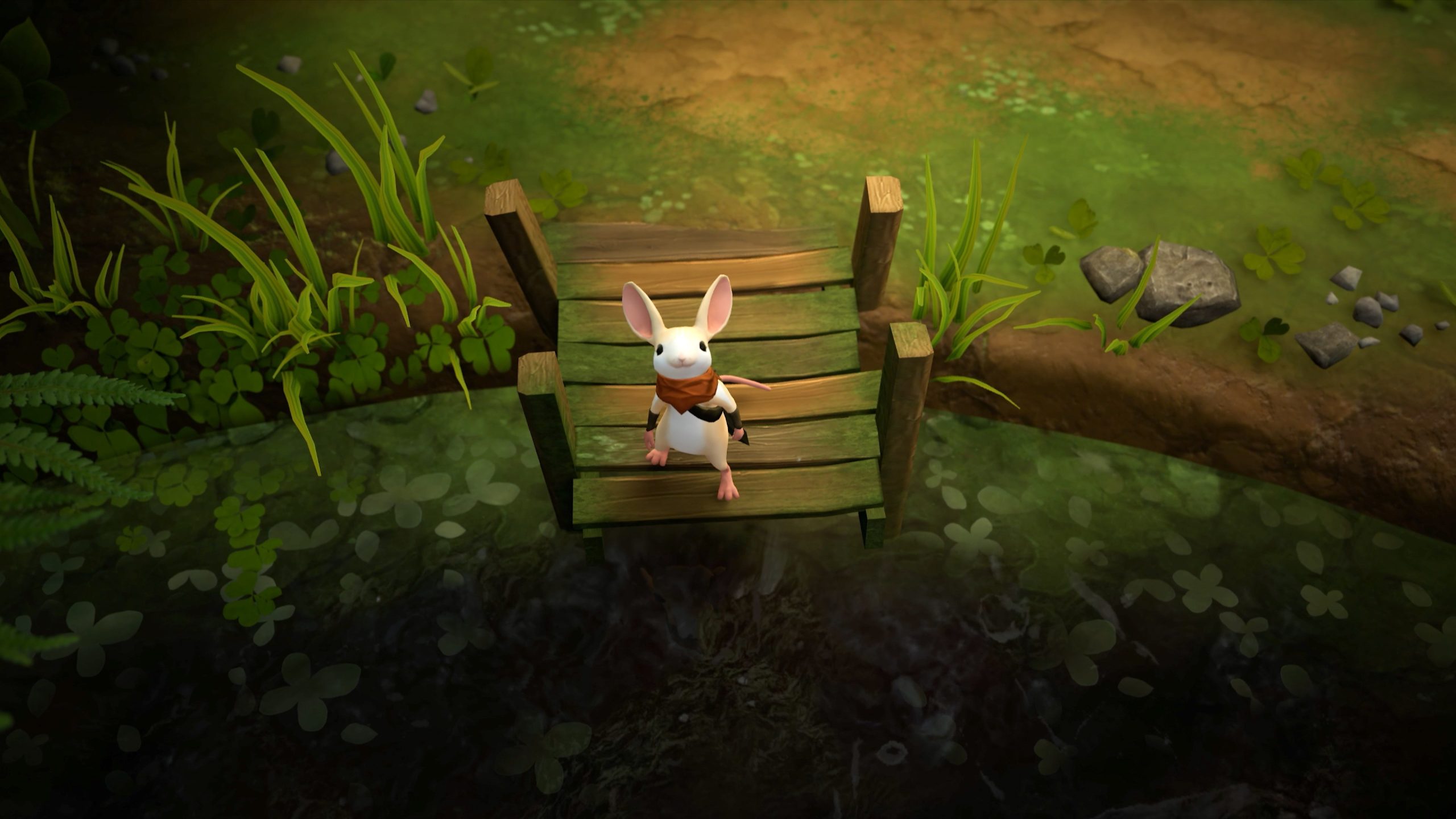
Treat Yourself to a Wholly Immersive 3D Adventure Double-Bill
There’s been a lot of talk about console exclusivity in the past month – mostly surrounding Xbox ‘losing’ exclusives and PlayStation ringfencing their own – but among that news is a small win for Xbox. Moss, once exclusive to PSVR, has ditched the virtual reality goggles and escaped to other systems. It arrives in the form of Moss: The Forgotten Relic, a combining of both Moss I and Moss II into a single adventure.
The folding of the two games into a single ‘Forgotten Relic’ makes a great deal of sense. Moss II picks up seconds after Moss I, so it’s easy to squint and imagine them as a single epic. And epic is a strong descriptor for Moss: The Forgotten Relic.

Port it to Virtual Boy you Cowards
The first question we had when starting Moss: The Forgotten Relic was the virtual reality one. How can two games make the translation from virtual headsets to a controller? It feels like the clearest obstacle to success for the two games. Surely something would be lost.
The answer is that the Moss games were always an outlier on PSVR, and that outlier status makes them perfect for a translation to console. 80% of Moss is a traditional 3D action-platformer. Even on PS4, you were primarily using an analogue stick to move the main character (Quill) about dungeons that wouldn’t be out of place in a Legend of Zelda or Crash Bandicoot. It’s only when those rooms need interaction from the player (the ‘Reader’) that virtual reality intrudes. The player can pull blocks, control enemies and swing platforms.
That controller-friendliness means that the Moss games, more than most other VR games, ‘fits’ the Xbox. All that remained was to address the remaining 20%: making the god-like interactions of The Reader feel natural.
Playing God with the Reader
To keep the 80-20 theme running, the Reader controls are superb 80% of the time. Moss: The Forgotten Relic helpfully paints blocks and platforms in a kind of glow-in-the-dark Celtic pattern when you can tinker with them. Then you hold RT and begin pushing and pulling at them. There’s a satisfying heft to bigger blocks that remind that you are not necessarily omnipotent: you have limits to what you can manipulate. And there’s a real satisfaction to building a path for little Quill, and then switching back to them.
20% of the time it’s still awkward. When there are multiple Reader-interactions in close proximity, it can be hard work. In one Keeper boss encounter in Moss II, we found ourselves in tight corners with enemies, blocks and climbing walls, and we struggled to pull the right one into focus at speed. On other occasions, the camera would zoom in too close, leaving the interactable elements out of view.

These Reader puzzles work well enough to give Moss: The Forgotten Relic a distinct voice, which is a very good thing indeed as the rest is extremely polished, beautifully designed, but ultimately familiar. We don’t mean to be insulting here: Moss isn’t going to surprise you in the same way that TUNIC and Cocoon did. It’s not the brand of indie game to push against any boundaries. It instead takes the path of delivering a consummate 3D platform-adventure, and that path is an entirely valid and enjoyable one.
There’s a Mouse Guard and Redwall-like seriousness and scope to Moss’s story. The Arcane is searching for the Five Glass (think Infinity Stones and you’re pretty much there) so that they can take over the world. The Glass are defended by various benevolent races, but they’re no match for Sarffog the snake and Tylan the Owl, both of whom seek to burn the world. The only option is to gather the Glass before the Arcane does, and use them to fight back – something that the sprites and other races vowed never to do. This is the path of Quill, who is a ‘Twofold’, thanks to her connection to a Reader. That’s you that is.
We’ve Just Realised This is a ‘Twofold’ Game, Because There are Two Games
The adventure takes you into some absolutely gorgeously overgrown environments. Moss II even manages to find room to step the quality up even higher, setting most of its levels at the foot of giant fae constructions. Across the board, the production quality is sky-high. It must have looked gorgeous with PSVR goggles on, but it’s even better here.
The adventure is mostly puzzle exploration mixed with a smidge of combat. That 80-20% proportion works again: 80% of the time you are arriving in a large empty cavern that would get Lara Croft unpacking her carabiners. There is a vague indication of where you need to get to, and it’s down to your wits, your accumulated abilities, and your Reader-powers to determine whether you get there. There’s a fair amount of Metroidvania blockages and backtracking too, as you find an unlock that helps you to progress.
These puzzles are clever but never onerous. It’s entirely possible to play Moss: The Forgotten Relic as a pass-the-pad with a younger family member, for example. Most of the time, you can get through by following the onscreen cues – scratched rocks indicate something to mantle, green leaves point to something climbable – and then stop when you get blocked. Then it’s working out whether Moss or the Reader is the one to unblock it.
These puzzles are elegant and clever, as well as being almost entirely immersive. There are very few moments where the fourth wall is broken – aside from when Quill cutely requests a high-five. The only negatives I have are when this adherence to immersion goes a little too far: it’s sometimes hard to discern whether a platform is within reach, higher or lower, or whether Quill will grab the ledge if he misses. The rules are somewhat arbitrary.

Are you a Man or a Mouse?
Combat is thankfully thin on the ground. Don’t get us wrong – it’s fine. But it’s clearly a drop in quality from the intricate puzzles and exploration into the unknown. I mostly wanted to shoo it out of the way so that I could get on with the good stuff. There’s only a single attack and a dodge, and the Reader can occasionally fumble into battle, dragging enemies away. But it’s simplistic and slightly uncoordinated.
On balance I adored Moss: The Forgotten Relic. I haven’t mentioned some of the more spoiler-able moments, particularly in Moss II, when the designers seem to say “oh, you thought we were derivative?” and takes the adventure into a wild left-turn. I felt like Moss II was a significant step up from Moss I in every way: still ‘of a piece’, but a big-budget expansion on everything that came before.
Moss: The Forgotten Relic is about as rich as an adventure game can get. It might not be overly groundbreaking, and the port from PSVR has left some control quirks behind, but everything else is so enthralling and elegantly constructed that you tend to push those thoughts aside. It’s as immersive as a top-tier animated movie.
Most of all, in this heat, I am just thankful that I haven’t got some sodding great virtual reality goggles pressed against my head.
Important Links
Buy from the Xbox Store – https://www.xbox.com/en-gb/games/store/moss-the-forgotten-relic/9mwd01zn4wd1