Takes a Sliding Puzzle and Split it Cleanly in Two
The puzzle-makers over at Afil Games have clearly got a whiteboard up in a meeting room with the phrase ‘How can we make sliding puzzles more interesting?’ written across the top. In a short span of time, we’ve had the introduction of magnets in Magnetail and DIY walls in Damways. Next on the list is Split Crystal, which allows you to cast a spell on the blocks you’re pushing about, and split them into two blocks.
Out of all of Afil Games’ gonzo ideas for reworking the sliding puzzle genre, this is my favourite. Adding magnets in Magnetail made things easier rather than more challenging, while the build-a-blocks in Damways were fine but got tired after a time. Being able to blow up blocks, then reform them into super-blocks, is wackier, more satisfying, and lets you do things that the designers probably didn’t intend. It’s great fun.

Find a Crystal, Pick it up, for the Rest of the day You’ll Have Good Luck
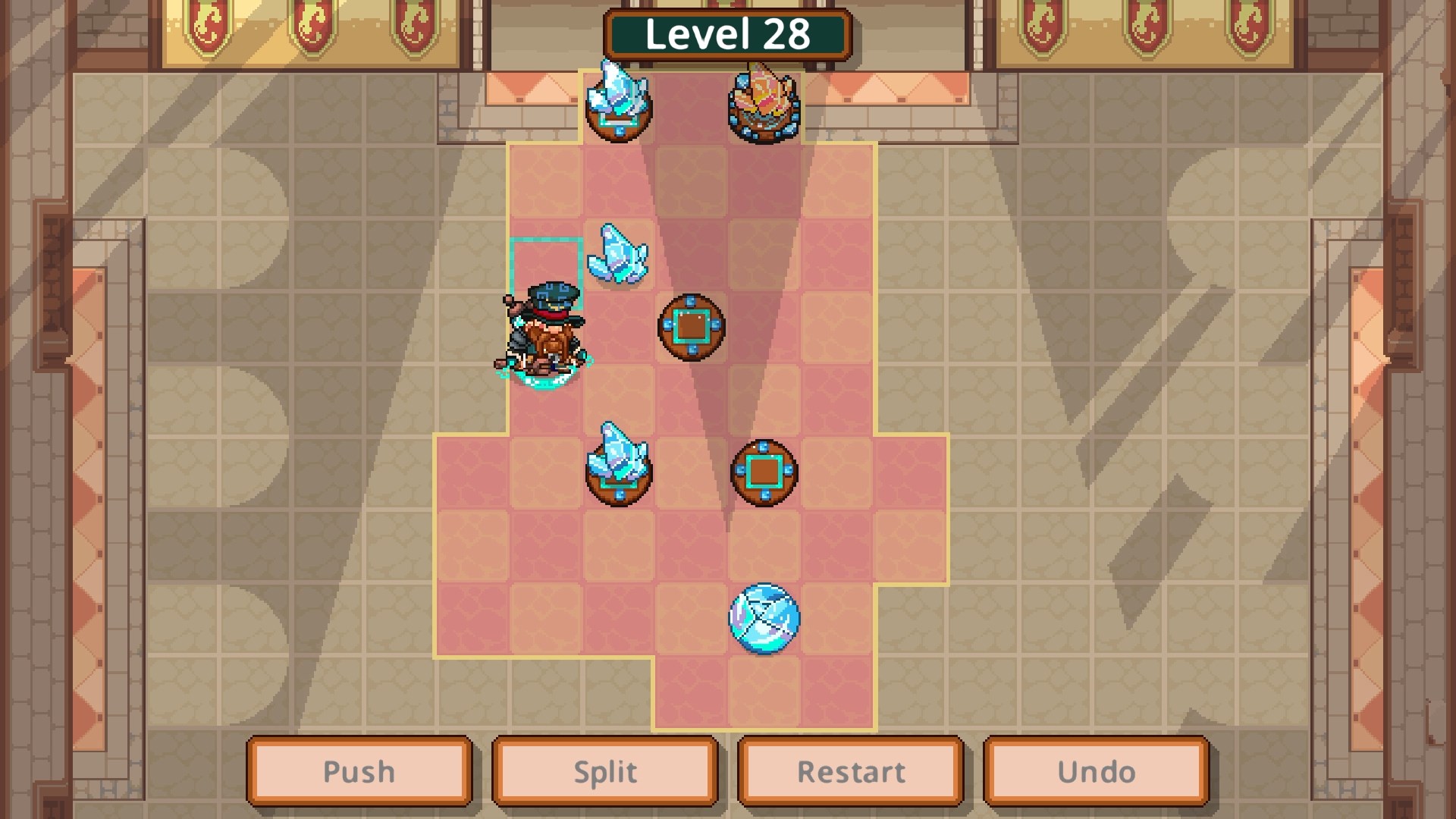
Let’s remove the whole ‘splitting’ thing for the moment to explain the basics. Split Crystal is a hybrid sokoban and sliding puzzle, which seem to be all the rage at Afil Games right now. You can amble over to a crystal in Split Crystal and aim towards it, tapping X to push it. Pushing a crystal slides it across the arena until it hits an obstacle. If there’s nothing blocking it, it can slide from one end of the grid to the other.
The aim is to get these crystals into a ritual circle. You will need to shunt them from wall to wall until the crystal is lined up with the circle, and then it’s one final push. The opening few levels simply require you to slot crystals into circles in this way.
Then things get interesting. Split Crystal introduces multiple crystals. In any other sliding puzzle, one crystal would act as a mobile wall for the other one. But Split Crystal is a little different. If you slide a crystal into another crystal, they conjoin to create a kind of uber-crystal. That bigger crystal can be moved like any other crystal, but the difference is that some ritual circles look different from others. These circles require the uber-crystal to be slotted in rather than the single smaller crystals. You need to make sure that you’ve done a spot of merging before you finish.
Breaking the Rules With a Waft of the Wand
It doesn’t stop there. The little wizard that you control has the power of sorcery at his wand-tips, so you can also split the crystals, as per the title. Approach one of these uber-crystals and point your wand at it (pressing A rather than X), and you can force it to separate. Where these two half-crystals appear is dependent on where you stood when you split them. They tend to appear one square to the left and one square to the right of the source crystal.

We say ‘tend to’ appear in this way, because they don’t always. If there is a wall, block or other crystal in the way, then it’s a bit of a roll of the dice. It’s not always clear where the crystals are going to appear, and this is both a boon and a bugger. It’s a boon because it can often work out in your favour, and I found myself shattering crystals just to see what it does (and then Undo-ing if it didn’t help me out). But it’s a bugger in the sense that there’s unpredictability when you might not want it.
I’m not sure why Split Crystal didn’t go as far as to display where the crystals are going to land before you split them. It would have taken a small amount of time to create a kind of shadow-crystal to show where your actions might lead. But while I found the system a little chaotic, I kind of revelled in that chaos. And when I say revelled, I mean I exploited it for my own gain whenever I could.
Like Carrying Your Own Cheat Codes
In sliding puzzles, I will often find myself one square away from where I wanted to be. That’s just how sliding puzzles work: they like to taunt you with dead-ends and red-herrings. But in Split Crystal, you have a weapon that works to your advantage. You can join crystals and split them, over and over again, until you’ve got something that works for you. And that was oddly satisfying. I felt like I was exploiting a bug, when I suspect that the designers actually want me to do this.
It’s not all exploitation of course. I’d also complete levels as intended and feel like a bit of a boss for doing it. Sliding a crystal into a single block, then splitting the crystal so that they sit either side of the block is a basic trick which never stops feeling good. It’s also great to join together crystals as much as possible, simply because it gives you more options later on. You can get close to the ritual circles and then split and rejoin to see if you’re better off in any given permutation.
Unlike Damways and Magentail, which left me in doubt whether their gimmicks actually improved their sliding puzzles, I am in no doubt that Split Crystal is improved through its own gimmick. The levels take a step away from ‘puzzle’ and a step closer to ‘creative expression’. Sure, you are often strategising how to complete a level, but there will likely be more than one solution, and you can find your own path to it.

A Puzzle game that will Split Opinions
Puzzle players who like a single solution, and want to come to that solution on their own, might be less impressed with Split Crystal than me. But I found Split Crystal to be a sliding puzzle that took things in a completely new direction. It got me cheating rather than playing by the rules, and that was fun and a little glamorous.
If Afil Games are exploring different ways of approaching all of their usual genres, then Split Crystal is one of their successes. Hopefully they can draw the right learnings from it, as I’d be happy to chuck down £4.19 for askew versions of classics like this.
Important Links
Buy an Xbox Series X|S Optimised version – https://www.xbox.com/en-GB/games/store/split-crystal-windows/9P9RV64P8X9P/0010
Buy an Xbox One edition – https://www.xbox.com/en-GB/games/store/split-crystal-xbox-one/9NH2P1L126C2/0010
There’s a Windows PC drop too – https://www.xbox.com/en-GB/games/store/split-crystal-windows/9P9RV64P8X9P/0010