A pillar of Konami’s classic console library finally returns… in Japan, at least.
In case you missed these announcements, allow me to preface this round-up with two rather grave announcements from Sony: firstly, they intend to finally close the digital PlayStation 3 and Vita stores starting from as early as this August, depending on region, and secondly, they intend to cease production of physical diss for new game releases across all PlayStation consoles from 2028.Y’all know how to hack your consoles, right?
ARCADE ARCHIVES / ARCADE ARCHIVES 2
Lady Bug
- Platform: Nintendo Switch 2, PlayStation 5, Xbox Series S/X (worldwide, ACA2) / Nintendo Switch, PlayStation 4 (worldwide, ACA)
- Price: $9.99 / €8.99 / £7.39 (ACA2), $7.99 / €6.99 / £6.29 (ACA), $2.99 / €2.99 / £2.49 (ACA-to-ACA2 upgrade)
- Publisher: Hamster / Universal
What’s this? A Pac-Man-esque dot-eating maze game, originally developed and distributed by Universal in 1981 and made famous in North America via Coleco’s conversions for the Colecovision and Intellivision in 1982 and 1983, respectively. Players control a ladybug with the goal of collecting all of the flowers within each maze while dodging enemy insects that spawn from the center of the screen; unique features include rotating turnstiles that allow one to dynamically reshape the walls of the maze, skull items that kill player and enemy alike, letter items that award lives and even credits upon spelling certain words and more.
Why should I care? You’re interested in playing a game considered by many to be the most ambitious and well-crafted of the immediate post-Pac maze games, or you’re familiar with those early home versions and want to verify for yourself that they really are remarkably close to the original. You might also be interested to observe just how many elements designer Kazutoshi Ueda recycled between their early arcade games: Lady Bug, Mr. Do, Bomb Jack…
Useless fact: Lady Bug also broke ground by being one of the very first games to feature an officially-licensed rendition of a pop song — in this case, “Tentomushi no Samba (Ladybug Samba)” by the group Cherish — but the tune has been edited to a legally-distinct version for this reissue.
CONSOLE ARCHIVES
.T.R.A.G. – Mission of Mercy / Hard Edge (PlayStation)
- Platform: Nintendo Switch 2, PlayStation 5 (worldwide)
- Price: $11.99 / €10.99 / £9.89
- Publisher: Hamster / Sunsoft
What’s this? A post-Resident Evil multi-character sci-fi action-adventure game, originally developed and distributed worldwide by Sunsoft for the original PlayStation in 1999 (titled Hard Edge in Japan and Europe), and reissued via PS Classics in 2007. Players lead the four-person Tactical Rescue Assault Group on a mission to liberate a skyscraper from a terrorist occupation; while adopting the format popularized by Resident Evil — that is, a Hollywood-esque story delivered via tank-controlled 3D characters superimposed onto pre-rendered 2D backdrops — the game differentiates itself through the inclusion of multiple, freely-selectable playable characters, a higher emphasis on melee combat complete with command-input attacks and a decidedly anime-style character aesthetic.
Why should I care? You’re looking to experience one of the most ridiculous games from an era and format of game that was, at its baseline, already kooky.
Helpful tip: This reissue’s dropping ahead of Hard Edge – War Zone, a brand-new game from modern-day Sunsoft that reinterprets the world and characters of the original as a real-time, card-based 4v4 tactics game, due out any day now.
EGG CONSOLE
Relics(MSX2)
- Platform: Nintendo Switch (worldwide)
- Price: $7.19 / ¥990
- Publisher: D4 Enterprise / Bothtec
What’s this? The MSX2 version of Bothtec’s side-scrolling sci-fi adventure game Relics, originally developed for PC-98 computers and very quickly ported to a great many other Japanese computers, including an immediate PC-88 port that doubled as the debut EGG Console release a couple years back. Set inside a mysterious ruins, players control a formless soul with no memories of its former life but the ability to possess the body of any creature it kills; each controllable entity has its own stats and abilities, some obvious and some not, and it is up to the player to determine their objectives and goals and the purpose of their existence within the ruins. (Because I missed it: this specific version also hit Steam a couple weeks back.)
Why should I care? I cannot speak to the particular perks or advantages of this port vs. others (and at a glance, there don’t seem to be any in particular) but I can say that this is a game made explicitly for people who relish in deciphering opaque and intentionally vague game systems that present as open-ended but can realistically be rendered down to performing a relatively brief string of very specific actions. (If you’ve played the Famicom Disk System adaptation, you might want to give one of the computer versions a try, too, if only to see what it’s like without lengthy loads every few seconds.)
Language barrier? The intros and endings are in Japanese; the in-game text is primarily presented in English, not that it’ll do you much good.
NEOGEO PREMIUM SELECTION
Ninja Master’s -Haoh Ninpouchou-
- Platform: PC via Steam (worldwide)
- Price: $19.99 or equivalent
- Publisher: SNK / Code Mystics
What’s this? A gritty ninja-themed fighting gameset in a fictionalised version of 1800s “Zipangu”, originally developed by ADK and distributed by SNK for Neogeo MVS, AES and CD in 1996, with reissues via Wii Virtual Console, Arcade Archives Neogeo, the PlayStation 2 ADK Tamashii compilation and more; as with other Premium Selection reissues, this version comes equipped with rollback netcode and online lobbies, a detailed training mode, art galleries and more, but doesn’t offer any major enhancements beyond making the bosses selectable by default.
Why should I care? Where most of the prior Premium Selection games have possessed some latent amount of competitive integrity, this one’s very openly busted, but that’s not to say it’s not without its charms: the very somber tone sets it apart from SNK’s own ancient-Japan fighting games and especially ADK’s other extremely wacky fighting and/or ninja-themed games, and the signature weapon/bare-handed stance-switching and extremely open-ended combo system offer a lot to anyone who’s amenable to the notion of both delivering or receiving a touch-of-death combo at any second.
Useless fact: Yes, the apostrophe in the title is official; yes, it bugs me, too.
OTHER
Dokapon 3-2-1 Super Collection!
- Platform: Nintendo Switch (Japan)
- Price: $19.99 or equivalent
- Publisher: Sting
What’s this? A PC port of the recent Japan-only emulated collection for Switch containing the three Super Famicom entries in Asmik Ace’s (now Sting’s) long-running, friendship-destroying RPG boardgame series Dokapon:1993’s Kessen! Dokapon Oukoku IV: Densetsu no Yuusha Tachi (remade and localized for Nintendo DS as Dokapon Journey), 1994’s Dokapon 3-2-1 – Arashi o Yobu Yuujou (remade and localized for Nintendo Wii as Dokapon Kingdom and recently remastered for Switch and PC with online play as Dokapon Kingdom Connect) and 1995’s Dokapon Gaiden: Honoo no Audition, presented here with save states, a 3x turbo setting and the ability to view scans of the original manuals while you play, as well as new illustrations by original artist and mangaka Ami Shibata. (This Steam release remains entirely in Japanese: no localized games, not even a localized front-end.)
Why should I care? You want to spend money on versions of these games that do, by way of Steam Remote Play, feature online multiplayer — or, to put it another way, you require versions of these games that allow you to play with other people without being in the same room as them, thereby thwarting their ability to murder you after you ruin their lives.
Useless fact: Sting recently released a second, new-generation RPG-themed boardgame on Steam called Viractal that adopts a lot of modern design conventions and a more co-operative bent with only a fraction of the relationship-ruining sabotage of Dokapon; it’s been getting regular updates, including collaborations with other Sting series including Baroque and Yggdra Union, and it’ll be getting a complete release on consoles later in October.
Ganbare Goemon Daishuugo!
- Platform: PlayStation 5, Nintendo Switch, PC via Steam (Japan)
- Price: ¥5478
- Publisher:Konami
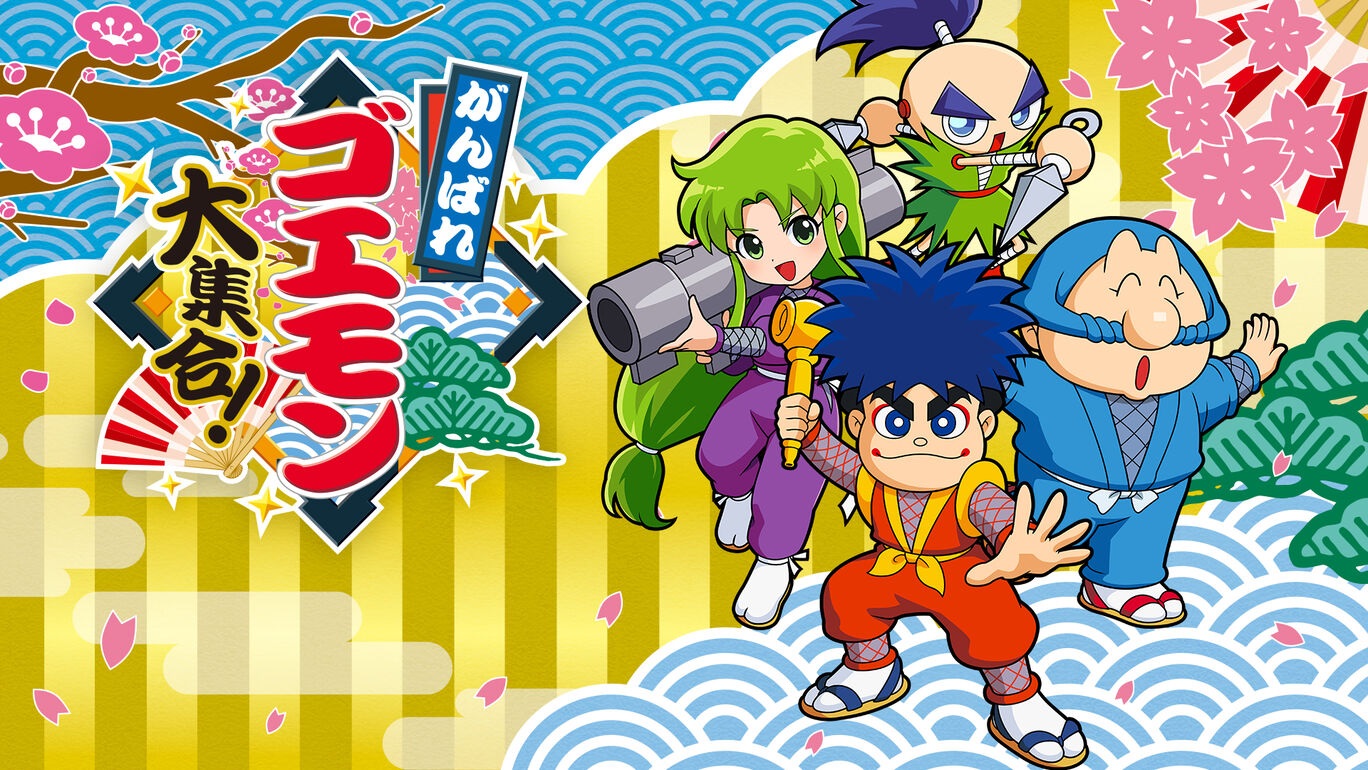
What’s this? A compilation containing 13 Famicom, Super Famicom and/or Game Boy/Color entries from Konami’s classic Ganbare Goemon series of silly jidaegeki-themed games, largely but not always of the action variety and very sporadically localized under the title Legend of the Mystical Ninja and/or Mystical Ninja Starring Goemon; developed by emulation artisans M2, this collection augments all games with save states, rewind, configurable controls (including various rapid-fire settings for games with specific button-mashing requirements), turbo speed settings where appropriate, on-screen explanations for items and/or mechanics that are not explained by the games themselves, a voluminous customizable sound player with roughly 600 songs and more. (Do note that the Steam version is only available to those with a Japanese Steam account.)
Which games are included? This collection includes the mainline Famicom games Ganbare Goemon: Karakuri Douchuu and Ganbare Goemon 2, the mainline Super Famicom games Ganbare Goemon: Yukihime Kyuushutsu Emaki (originally released worldwide as Legend of the Mystical Ninja), Ganbare Goemon 2: Kiteretsu Shogun McGuinness, Ganbare Goemon 3: Shishijuurokubei no Karakuri Manji Gatame and Ganbare Goemon Kirakira Douchuu: Boku ga Dancer ni Natta Wake, the mainline Game Boy games Ganbare Goemon: Sarawareta Ebisumaru! and Ganbare Goemon: Kurofune-tou no Nazo (originally released worldwide as Mystical Ninja Starring Goemon), the mainline Game Boy Color games Ganbare Goemon: Tengo-tou no Gyakushu! and Ganbare Goemon: Seikuushi Dynamites Arawaru!!, plus the Famicom RPG spinoffs Ganbare Goemon Gaiden: Kieta Ougon Kiseru and Ganbare Goemon Gaiden 2: Tenka no Zaihou and the Super Famicom puzzle-action spinoff Soreyuke Ebisumaru Karakuri Meiro: Kieta Goemon no Nazo!!. (Do note that none of these games have been translated into English, nor does this collection contain the English versions of games that were localized in their day. There’s also one extra game, detailed below…)
Why should I care? Y’know how every iteration of every Nintendo-borne classic games initiative is inundated with requests for Super Mario RPG or Chrono Trigger or Earthbound or one of the other small handful of games, day after day and week after week until they finally do or don’t show up? Well, the Ganbare Goemon series has assumed that role in Japan: most of the series has not been reissued in any form and even the most popular entries have been absent from modern storefronts since the Virtual Console days, and their absence has only become more conspcious as the years went on, so the fact that a large portion of the series is now back in one well-produced and bountiful package is, to many people of a certain age, a Big Deal. The games themselves largely hold up, too (and where they don’t, they’re ably augmented by the collection’s assist features) and encapsulate a certain playful excess, both creatively and technically, that sits a little askew of but is by no means inferior to the Konami console heavy-hitters of the day like Castlevania and Contra. Now, it’s certainly disappointing that the games have not been localized, but the fact that they made a point of region-locking the Steam release suggests to me that they might still be hunting for a way to finance an international, localized release, so here’s hoping…
Helpful tip: This collection contains a secret fourteenth game, which was not advertised nor hinted at anywhere within the game itself, but has already been discovered by fans and formally revealed by the developers: Crisis Wing, a 1991 Famicom-exclusive vertical shooter and late-era technical showpiece, can be played by initiating the staff roll present in the main options menu and entering the Konami Code. (unlike the rest of the collection, whose games have been optimized and presented by default without deficiencies like slowdown or flicker, Crisis Force specifically reproduces all the slowdown and flicker as a tribute to just how hard it was pushing the Famicom to do what it’s doing.)
UPDATES UPDATES UPDATES
Raiden Fighters Remix Collection (PlayStation 5, Switch, PC) major update #2

This second patch for the much-troubled Raiden Fighters Remix Collection adds quick-restart functionality, a new optional pixel-smoothing filter, fixes to the button config and various other bug tweaks, as well as support for PS4 arcade controllers on PS5; it’s being promoted as the final major patch, and while the game could certainly use more updates to address issues like input lag, one might at least find these releases to now be adequately playable.
Rose & Camelia Collection (Switch) online multiplayer update
Just in time for EVO!